
Among the many strands of the 1890s, two quite different versions of “aestheticism” contended for the loyalty of young writers. On the one hand stood the Oxford inheritance of Walter Pater, with its quietism, discipline of attention, and reverent seriousness about beauty. On the other stood the flash and glitter of the London decadents, the brilliant but unstable constellation revolving around Oscar Wilde and Lord Alfred Douglas. These two worlds overlapped, but they were not identical — and for Olive Custance, the difference mattered profoundly.
In several articles on this site, I have already noted that Olive’s early diaries record her passionate admiration for Pater’s Marius the Epicurean, which she described as a revelation. She felt the book expressed “her own soul in prose,” confirming her instinct that art and moral seriousness not only could coexist but were meant to. When Pater died in 1894, she imagined him ascending “to a fairer life,” clothed in “glorious golden robes, tainted with martyr’s blood.” For Olive, Pater was no ordinary critic. He was a kind of priest.
This sacramental view of beauty brings Olive into close alignment with Lionel Johnson, the shy, intense poet who became — after Pater — one of the principal guardians of “spiritual aestheticism.” Johnson’s elegy for Pater, quoted elsewhere on this site, captures the tone perfectly:
“With mind serene, and spirit pure,
And ardent still for truth and right,
He walked his way, aloof, demure,
A scholar and a saint in light.Hierarch of the spirit, pure and strong,
Worthy Uranian song,
He wrought his appointed will;
And now, at last, is still.”“O quiet heart, O tender heart,
O deep and secret soul,
A finer part, a fairer part,
Has claimed thee for its goal.”
Here Johnson reaches for Platonic language — Uranian in its 19th-century sense of the “heavenly,” purified eros that draws the soul toward the Beautiful. This is far from the theatricality of the Wildean epigram. Johnson’s “Uranian song” is a devotion. In his vision, Pater becomes a celebrant of an interior liturgy — the high priest of cultural contemplation.
The Lane Circle: A Fellowship of Earnest Souls
It is within this Paterian lineage that we should also place John Gray and Ernest Dowson, both of whom Olive knew and admired — and whose temperaments resonate strongly with her own.
John Gray
John Gray, despite later caricature as Wilde’s “Dorian,” was at heart one of the most serious, ascetic, and spiritually driven writers of the decade. Long before his conversion to Catholicism, Gray’s poems had a delicacy, inwardness, and stillness that drew Olive’s attention. His presence in the aesthetic movement was never flamboyant. He was, even as a young man, a figure of inward discipline and refinement — the closest, in many ways, to a true Paterian disciple.
Gray’s later priesthood, his intense spiritual life, and the severe beauty of poems like “The Well of Narcissus” or “In the Evening of Time,” all speak to the same sensibility Olive cherished: beauty as something solemn, exacting, and morally resonant.
Ernest Dowson
Ernest Dowson, too, belongs in this company — not because his life was serene (it was tragic), but because his ideals were. Dowson’s famous “Cynara” and his quieter lyrics radiate a chastened melancholy and an almost religious sensitivity. His yearning for innocence, purity, and unattainable beauty aligns very closely with Olive’s own emotional palette.
Though plagued by alcohol and heartbreak, Dowson was never a decadent in the Wildean sense. His emotions were too sincere, too unguarded, too bruised. His work possesses none of the ironic sparkle of Oxford wits; it trembles instead with longing. In that sense, Dowson stood much nearer to Pater’s reflective seriousness than to the decorative theatrics of the Wilde–Douglas circle.
Two Aestheticisms: London and Oxford
This distinction is important, because it allows us to draw a defensible line between two cultural constellations:
1. The Wilde–Douglas circle (Oxford + Café Royal)
- theatrical
- erotic
- epigrammatic
- self-dramatising
- aestheticism as pose and performance
- prone to scandal and melodrama
- full of brilliance, but morally unstable
Even Wilde, whose inner life was far deeper than the caricature, nurtured a younger set who embraced appearance more readily than depth.
2. The Lane/Yellow Book circle (London)
- reflective
- melancholy
- spiritually ambitious
- committed to beauty as moral seriousness
- inward, contemplative
- often tragically fragile, but fundamentally earnest
This circle — Johnson, Gray, Dowson, Harland, Symons, Beardsley — was not chaste, nor angelic, but its ideals inclined toward purity, discipline, and the moral weight of aesthetic experience. They were spiritual aesthetes rather than sensual ones.
Where Olive Custance Belongs
Placed between these two worlds, Olive Custance belongs unmistakably to the Pater–Johnson–Gray–Dowson side.
Her poetry, especially Opals and her later sequences, floats with dreamlike delicacy, but it also bears a chastened, almost devotional intensity. She seeks purity, self-command, visionary beauty. Even her fascination with Bosie can be understood through this lens. She saw in him — or wished to see — not the wayward protagonist of scandal, but the boy-poet of spiritual longing, the imagined vessel of the “Uranian dream.”
A Paterian Aestheticism of the Soul
If Johnson’s poem for Pater is the anthem of spiritualised aestheticism, then Olive’s diaries and poems form its feminine counterpart. Beauty, for her, was not mere diversion. It was an inner calling that demanded discipline, reverence, and surrender.
In an age often caricatured as decadent, Olive Custance stands as a witness to another possibility: a quiet, pure, exacting aestheticism, deeply moral, infused with longing for transcendence — a Paterian aestheticism of the soul.
It is into this lineage — Pater, Johnson, Gray, Dowson — that Olive consciously placed herself.
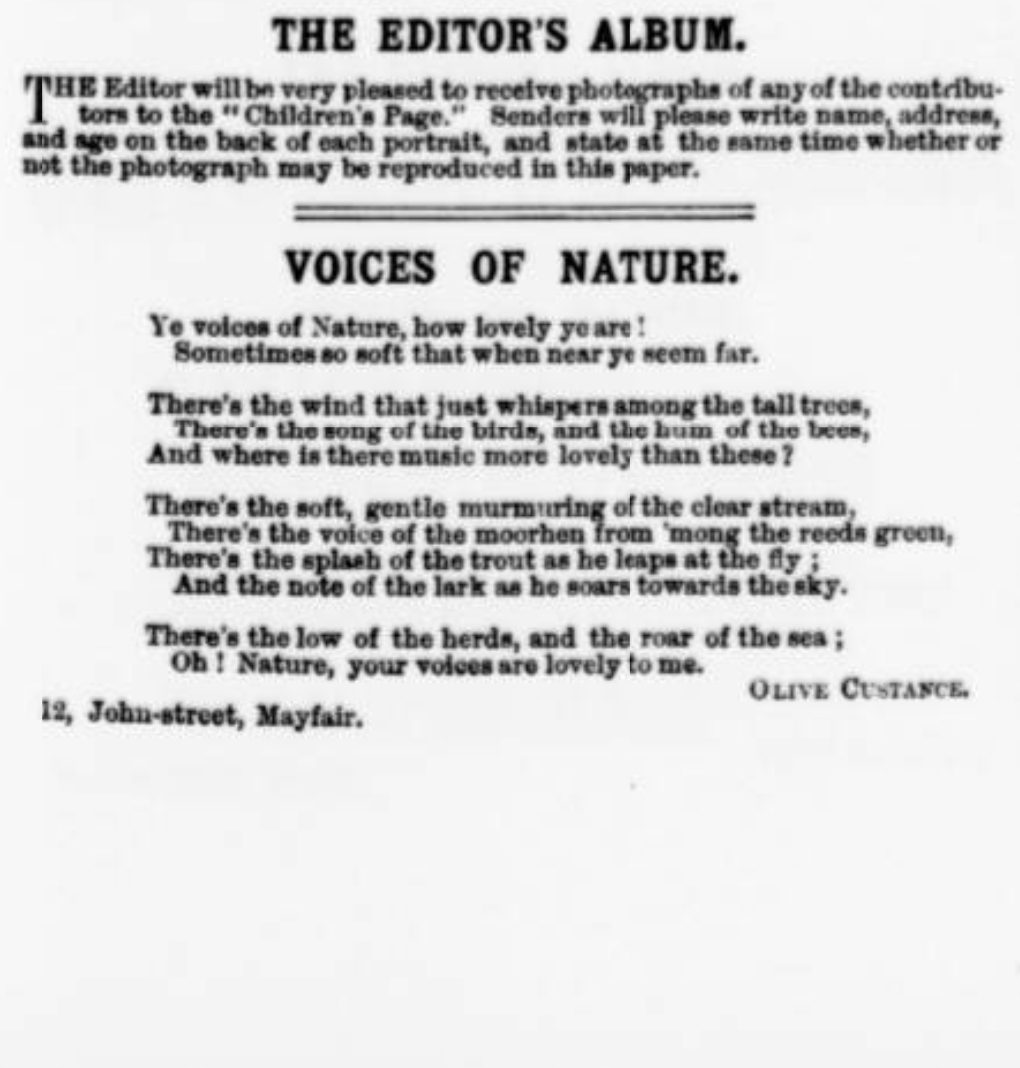
 Olive Custance (Lady Alfred Douglas)