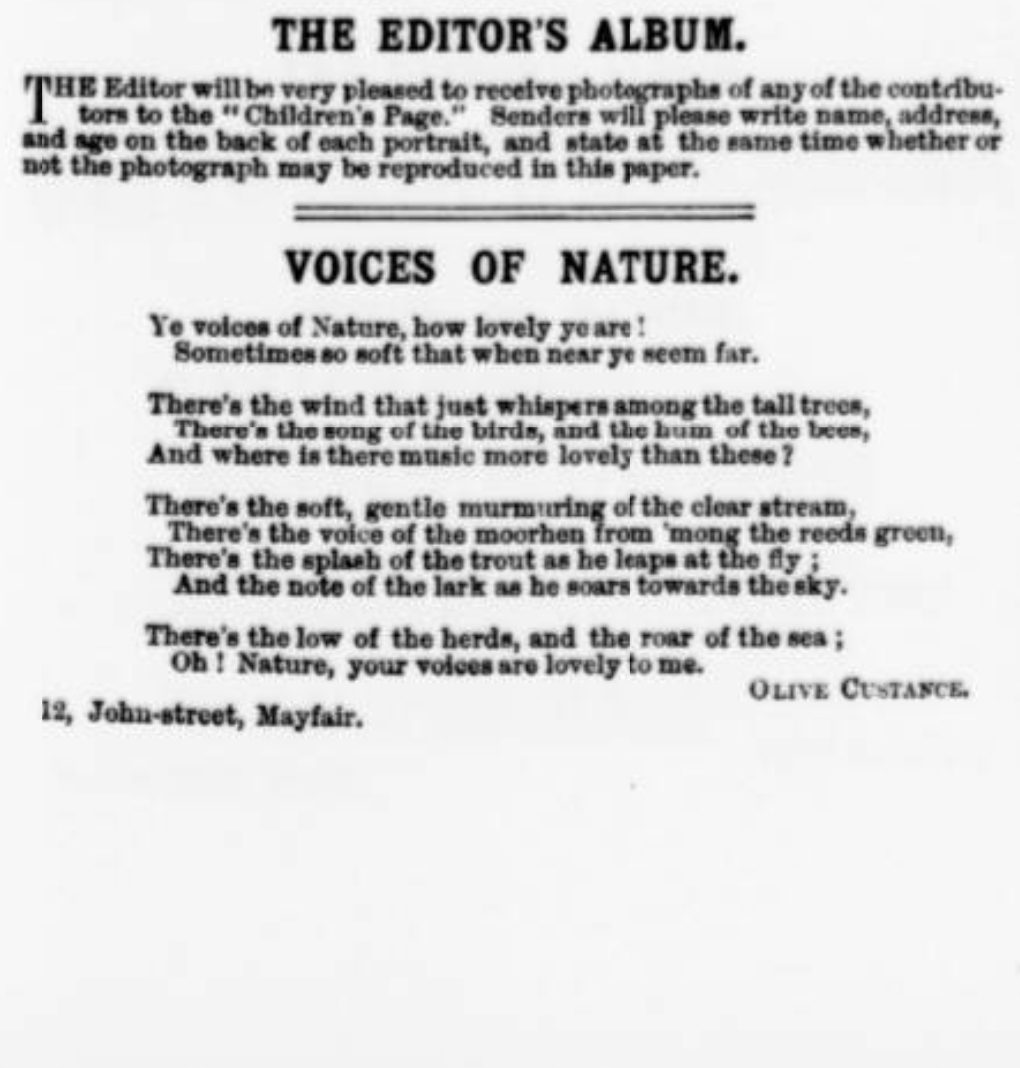
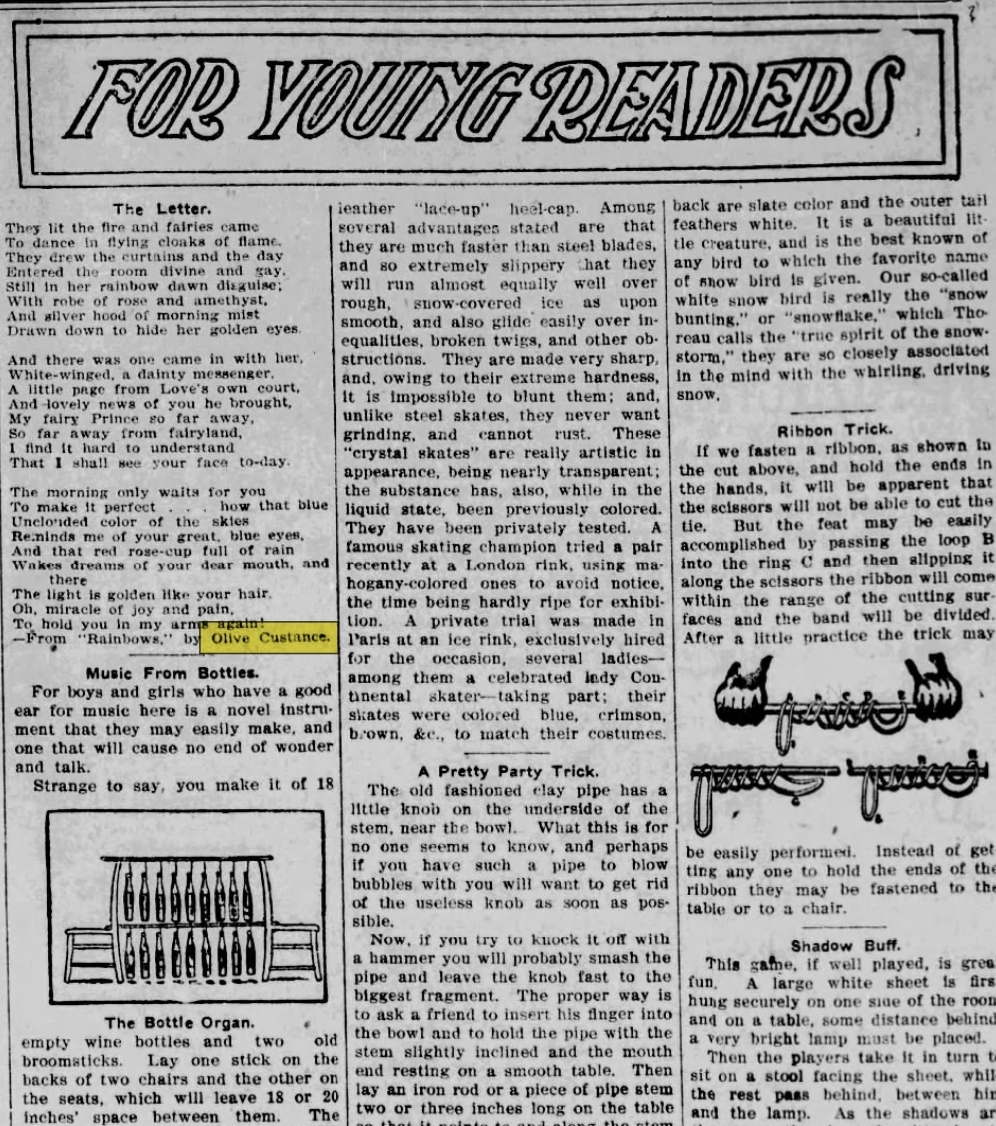
 In the spring of 1903, a little poem by Olive Custance travelled through the American press. “The Letter”, taken from her collection Rainbows, appeared in newspapers serving widely separated communities: from Louisiana to Montana, from Nebraska to Utah, and from Alabama to Minnesota. It brought its readers a domestic scene transformed by love: a lighted fire, the arrival of morning, and a letter promising the return of someone beloved.One recent search produced forty-two results, representing forty-one distinct newspaper appearances between 7 April and 14 May 1903, across fourteen present-day states. That is only a sample of the poem’s circulation, rather than a complete census. The example transcribed below comes from the Jennings Daily News, Louisiana, which printed it on 4 May, explicitly crediting “Rainbows, by Olive Custance”.1
An American audience before the marriage
By 1903, Custance’s American presence already had a history. Her poetry had been crossing the Atlantic during the 1890s, as American newspapers reproduced verse encountered in British periodicals. An especially clear example is the Boston Globe of 2 September 1898, which printed “After the Dance” with the credit “Olive Custance, in the Sketch”. Here the route from a British illustrated magazine to an American daily is acknowledged on the page itself.2
Readers also encountered her name through the visual culture of the period. On 3 April 1898, the Chicago Tribune reproduced the Beardsley bookplate bearing the words “Ex Libris Olive Custance”, captioning it “Last Bookplate Designed by Beardsley”. Her name was reaching American readers alongside one of the most recognisable artistic styles of the decade.3
Her marriage to Lord Alfred Douglas in March 1902 brought a further wave of attention. The Worcester Telegram, for example, carried an Associated Press report headed “Marries Another”, describing the surprise caused by the cancellation of her proposed marriage to George Montagu and the announcement that she had married Douglas instead.4 Such reports added personal celebrity to an existing literary presence. American readers had been encountering her poems well before she became Lady Alfred Douglas.
How far did a poem travel?
The surviving reprints suggest an audience much larger than the purchasers of Custance’s books. A newspaper copy might pass through several hands in a household, and a poem might be read aloud or cut out and kept. The appearance of a lyric in dozens of local papers gave it opportunities to enter everyday life that the sales of a poetry collection alone cannot measure.
A combined circulation of around 100,000 copies would, at an average of three readers per copy, put the potential newspaper audience at about 300,000. Those are illustrative assumptions, not yet a total established from the individual papers’ circulation records. They nevertheless indicate the scale worth considering. The United States had approximately 80.6 million inhabitants in 1903: a potential audience of 300,000 would represent roughly one person in 270.5
The more securely established point is the geographical breadth and repeated nature of her publication. A poet now given relatively little space in literary histories was appearing in the ordinary reading matter of American towns and cities. “The Letter” offers a particularly concentrated example of that wider pattern.
A broader appeal than her husband’s?
I suspect that Custance’s verse was more familiar to American newspaper readers than her husband’s. That is a judgment suggested by the breadth of her appeal and the reprints I have encountered, rather than a claim based on an exhaustive comparison. Douglas’s greater visibility today, especially through his association with Oscar Wilde, need not tell us whose poems were more often read at the breakfast table.
Custance’s poetry could address several readerships at once. It was beautiful aesthetic poetry, rich in colour, music and imaginative transformation; it could also delight children and speak directly to adults reading a women’s magazine, a women’s page or a newspaper’s literary miscellany. These audiences need not have been separate. A child could enjoy her dancing fairies while an older reader recognised the longing and desire carried by the same imagery.
In the Jennings clipping, “The Letter” appears immediately above “Music From Bottles”, a piece addressed to boys and girls. That juxtaposition does not make the poem a children’s poem, but it gives a glimpse of the mixed domestic readership into which her work could pass. The world of aesthetic poetry and the world of family reading were closer together than we sometimes imagine.
The Letter
By Olive Custance
They lit the fire and fairies came
To dance in flying cloaks of flame.
They drew the curtains and the day
Entered the room divine and gay,
Still in her rainbow dawn disguise;
With robe of rose and amethyst,
And silver hood of morning mist
Drawn down to hide her golden eyes.
And there was one came in with her,
White-winged, a dainty messenger,
A little page from Love’s own court,
And lovely news of you he brought,
My fairy Prince so far away,
So far away from fairyland,
I find it hard to understand
That I shall see your face to-day.
The morning only waits for you
To make it perfect . . . how that blue
Unclouded color of the skies
Reminds me of your great, blue eyes,
And that red rose-cup full of rain
Wakes dreams of your dear mouth, and there
The light is golden like your hair.
Oh, miracle of joy and pain,
To hold you in my arms again!
Transcribed from the Jennings Daily News, 4 May 1903, p. 6, where the poem is credited to Rainbows.
Fairies at the hearth
The opening is wonderfully economical. “They lit the fire” gives us an ordinary domestic action; before the line is over, fairies have arrived. The flames become dancers, their movement caught in the quick succession of “fairies”, “flying” and “flame”. Their cloaks are made of the very substance in which they dance. Fairyland begins in the hearth.
The same transformation follows when the curtains are drawn. Daylight enters as a splendidly dressed visitor, wearing rose and amethyst, with a silver hood and golden eyes. The colours belong to dawn, but they also become the materials of an imagined costume. Mist becomes fabric; light becomes a face. The room opens to the morning, and the morning enters a romance.
This is characteristic of the speaking voice we encounter here: sensuous observation becomes enchantment with remarkable ease. Familiar things acquire another life because they are being seen by someone whose imagination has been quickened by love. The warmth of the fire and the beauty of the dawn prepare the room for good news.
The white-winged letter
The title supplies the explanation for the second visitor. The “White-winged” page from “Love’s own court” is the letter itself, transformed into a living messenger. Its whiteness suggests the paper, while its wings allow it to cross the distance separating the lovers. An ordinary delivery becomes a courtly embassy.
At first, the speaker describes events as though telling a story: “They lit”, “They drew”, “And there was one”. Then the word “you” changes the relationship between speaker and reader. We find ourselves overhearing an intimate address. The fairy Prince is the person whose return matters to the woman speaking.
The repeated “So far away” briefly holds us inside the experience of separation. Then comes the news that overturns it: “I shall see your face to-day.” Her difficulty in understanding is the disbelief of happiness. Something long imagined is about to become real.
The time of waiting
The poem moves through time as delicately as it moves through the room. It begins with past-tense actions, passes into the speaker’s present wonder, and opens towards an imminent meeting. “To-day” brings fairyland into the calendar. The reunion belongs to this particular morning.
Yet anticipation changes the pace of that morning. “The morning only waits for you / To make it perfect” makes the whole world share the speaker’s expectancy. The pause after “perfect” allows her attention to wander across the visible scene. While she waits, everything becomes a reminder.
The last word, “again”, adds another dimension. This meeting is a return, carrying the memory of an earlier embrace. Remembered happiness and anticipated happiness converge in the present act of waiting.
Colour becomes a portrait
In the final stanza, the beloved’s body emerges from the landscape. The blue sky recalls his eyes; the red rose-cup suggests his mouth; the golden light becomes his hair. The colours that first clothed the personified morning now assemble a portrait of the absent lover.
The “rose-cup full of rain” is particularly sensuous. Colour, moisture and shape combine in an image that awakens the desire for a kiss. Custance’s fairy language leads naturally towards bodily tenderness. The final wish is entirely direct: “To hold you in my arms again!”
“Oh, miracle of joy and pain” gives the happiness its emotional depth. Even the prospect of fulfilment can hurt through its intensity. The predominantly four-beat lines and readily audible rhymes carry a musical, intimate voice, while the final stanza expands from eight lines to nine, allowing the closing exclamation an extra moment of release.
That combination helps us understand why the poem travelled so readily. Its imagery is richly coloured, but its emotional situation is immediately recognisable. A letter arrives; someone beloved is coming home; an ordinary morning becomes radiant. Readers did not need to know Custance’s literary circle to understand that transformation.
A note on the text and evidence
The transcription follows the Jennings newspaper witness, retaining its American spelling “color”.
The sample documents American appearances in a selection of important titles in some states; it should not be mistaken for a complete record of the poem’s international circulation. “Reprinted” is used here without assuming that every newspaper obtained its text through the same commercial arrangement.
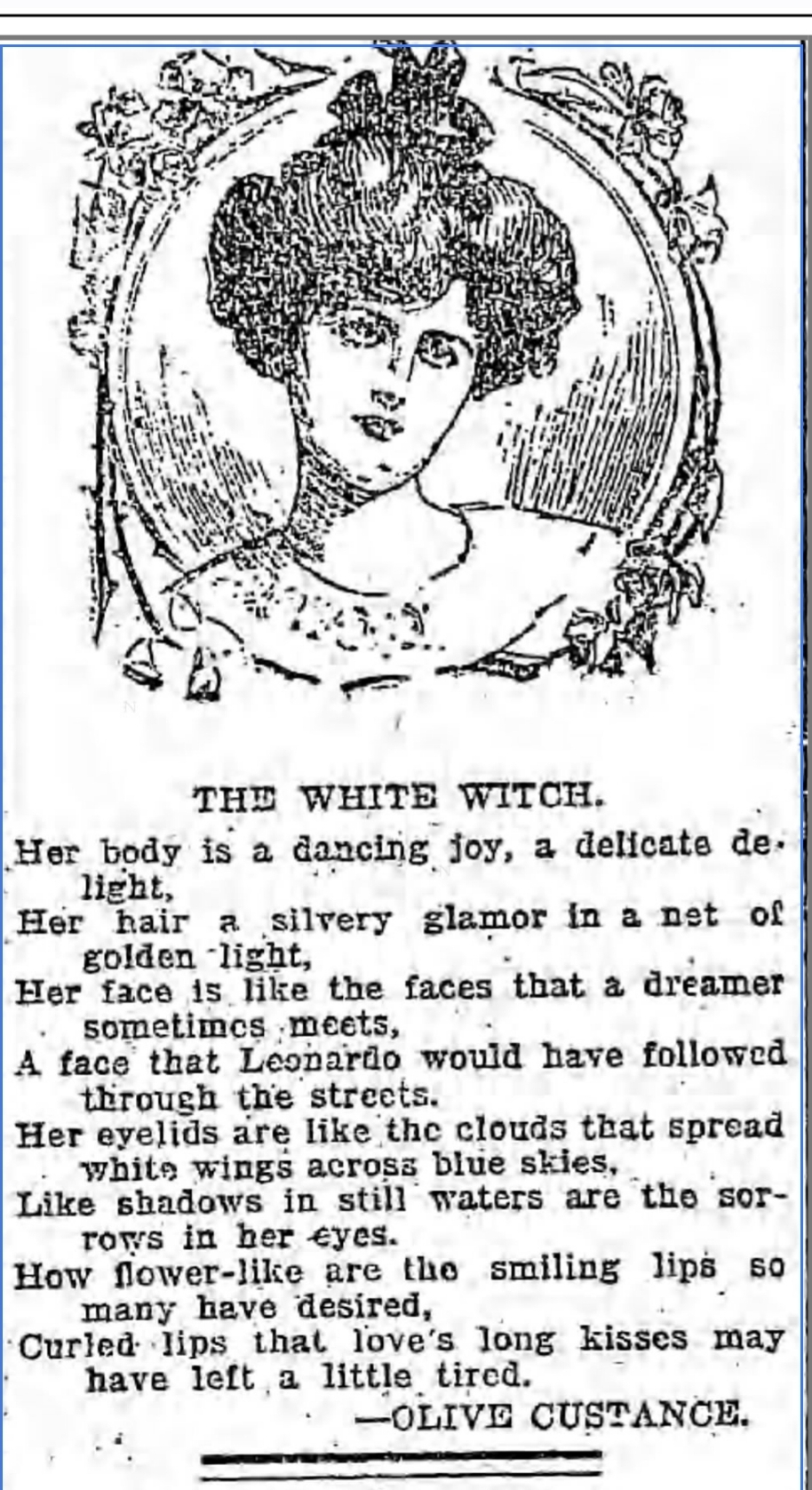
From The Sunday Times (Sydney, New South Wales, Australia) · Sun, Dec 13, 1903 · Page 24.
References
- Olive Custance, “The Letter”, Jennings Daily News
(Jennings, Louisiana), Monday 4 May 1903, p. 6.
Credited beneath the poem: “From ‘Rainbows,’ by Olive Custance.”
Newspapers.com page image.
See also Custance, Rainbows
(London: John Lane, The Bodley Head, 1902),
“Songs of a Fairy Princess”, III, “The Letter”, p. 11. - Olive Custance, “After the Dance”, Boston Globe,
Friday 2 September 1898, p. 6.
Attribution: “Olive Custance, in the Sketch.”
Newspapers.com page image. - “Last Bookplate Designed by Beardsley”,
Chicago Tribune, Sunday 3 April 1898, p. 63.
Reproduction of the bookplate inscribed “Ex Libris Olive Custance”.
Newspapers.com page image. - “Marries Another. Miss Olive Custance Gives Montagu and London a Surprise”,
Associated Press report, Worcester Telegram,
Friday 7 March 1902, p. 4.
Newspapers.com page image. - United States Census Bureau, historical population estimates:
approximately 80,632,000 inhabitants in 1903.
Historical population tables.
The readership calculation in this article is illustrative:
100,000 copies multiplied by three readers per copy. - Newspapers.com search for “Olive Custance” and “like your hair”,
restricted to 1903; results saved on 16 October 2026.
Forty-two results, including one duplicate issue,
yield forty-one distinct appearances dated 7 April–14 May 1903.
This search is a sample, not an exhaustive bibliography.