Tag Archives: Olive Custance

Olive Custance, Lionel Johnson, Walter Pater — and the Circle of Spiritualised Aestheticism

Among the many strands of the 1890s, two quite different versions of “aestheticism” contended for the loyalty of young writers. On the one hand stood the Oxford inheritance of Walter Pater, with its quietism, discipline of attention, and reverent seriousness about beauty. On the other stood the flash and glitter of the London decadents, the brilliant but unstable constellation revolving around Oscar Wilde and Lord Alfred Douglas. These two worlds overlapped, but they were not identical — and for Olive Custance, the difference mattered profoundly.

In several articles on this site, I have already noted that Olive’s early diaries record her passionate admiration for Pater’s Marius the Epicurean, which she described as a revelation. She felt the book expressed “her own soul in prose,” confirming her instinct that art and moral seriousness not only could coexist but were meant to. When Pater died in 1894, she imagined him ascending “to a fairer life,” clothed in “glorious golden robes, tainted with martyr’s blood.” For Olive, Pater was no ordinary critic. He was a kind of priest.

This sacramental view of beauty brings Olive into close alignment with Lionel Johnson, the shy, intense poet who became — after Pater — one of the principal guardians of “spiritual aestheticism.” Johnson’s elegy for Pater, quoted elsewhere on this site, captures the tone perfectly:

“With mind serene, and spirit pure,
And ardent still for truth and right,
He walked his way, aloof, demure,
A scholar and a saint in light.

Hierarch of the spirit, pure and strong,
Worthy Uranian song,
He wrought his appointed will;
And now, at last, is still.”

“O quiet heart, O tender heart,
O deep and secret soul,
A finer part, a fairer part,
Has claimed thee for its goal.”

Here Johnson reaches for Platonic language — Uranian in its 19th-century sense of the “heavenly,” purified eros that draws the soul toward the Beautiful. This is far from the theatricality of the Wildean epigram. Johnson’s “Uranian song” is a devotion. In his vision, Pater becomes a celebrant of an interior liturgy — the high priest of cultural contemplation.

The Lane Circle: A Fellowship of Earnest Souls

It is within this Paterian lineage that we should also place John Gray and Ernest Dowson, both of whom Olive knew and admired — and whose temperaments resonate strongly with her own.

John Gray

John Gray, despite later caricature as Wilde’s “Dorian,” was at heart one of the most serious, ascetic, and spiritually driven writers of the decade. Long before his conversion to Catholicism, Gray’s poems had a delicacy, inwardness, and stillness that drew Olive’s attention. His presence in the aesthetic movement was never flamboyant. He was, even as a young man, a figure of inward discipline and refinement — the closest, in many ways, to a true Paterian disciple.

Gray’s later priesthood, his intense spiritual life, and the severe beauty of poems like “The Well of Narcissus” or “In the Evening of Time,” all speak to the same sensibility Olive cherished: beauty as something solemn, exacting, and morally resonant.

Ernest Dowson

Ernest Dowson, too, belongs in this company — not because his life was serene (it was tragic), but because his ideals were. Dowson’s famous “Cynara” and his quieter lyrics radiate a chastened melancholy and an almost religious sensitivity. His yearning for innocence, purity, and unattainable beauty aligns very closely with Olive’s own emotional palette.

Though plagued by alcohol and heartbreak, Dowson was never a decadent in the Wildean sense. His emotions were too sincere, too unguarded, too bruised. His work possesses none of the ironic sparkle of Oxford wits; it trembles instead with longing. In that sense, Dowson stood much nearer to Pater’s reflective seriousness than to the decorative theatrics of the Wilde–Douglas circle.

Two Aestheticisms: London and Oxford

This distinction is important, because it allows us to draw a defensible line between two cultural constellations:

1. The Wilde–Douglas circle (Oxford + Café Royal)

  • theatrical
  • erotic
  • epigrammatic
  • self-dramatising
  • aestheticism as pose and performance
  • prone to scandal and melodrama
  • full of brilliance, but morally unstable

Even Wilde, whose inner life was far deeper than the caricature, nurtured a younger set who embraced appearance more readily than depth.

2. The Lane/Yellow Book circle (London)

  • reflective
  • melancholy
  • spiritually ambitious
  • committed to beauty as moral seriousness
  • inward, contemplative
  • often tragically fragile, but fundamentally earnest

This circle — Johnson, Gray, Dowson, Harland, Symons, Beardsley — was not chaste, nor angelic, but its ideals inclined toward purity, discipline, and the moral weight of aesthetic experience. They were spiritual aesthetes rather than sensual ones.

Where Olive Custance Belongs

Placed between these two worlds, Olive Custance belongs unmistakably to the Pater–Johnson–Gray–Dowson side.

Her poetry, especially Opals and her later sequences, floats with dreamlike delicacy, but it also bears a chastened, almost devotional intensity. She seeks purity, self-command, visionary beauty. Even her fascination with Bosie can be understood through this lens. She saw in him — or wished to see — not the wayward protagonist of scandal, but the boy-poet of spiritual longing, the imagined vessel of the “Uranian dream.”

A Paterian Aestheticism of the Soul

If Johnson’s poem for Pater is the anthem of spiritualised aestheticism, then Olive’s diaries and poems form its feminine counterpart. Beauty, for her, was not mere diversion. It was an inner calling that demanded discipline, reverence, and surrender.

In an age often caricatured as decadent, Olive Custance stands as a witness to another possibility: a quiet, pure, exacting aestheticism, deeply moral, infused with longing for transcendence — a Paterian aestheticism of the soul.

It is into this lineage — Pater, Johnson, Gray, Dowson — that Olive consciously placed herself.

Leave a comment

Filed under Uncategorized

Through the Garden Gate: Thomas Kilroy and the Redemption of the Douglases

Ferdi McDermott

I. Introduction – After the Curtain Falls

Some lives seem to end twice: once in the archive, and once again in the imagination. For the poet Olive Custance, her husband Lord Alfred Douglas (“Bosie”), and their son Raymond, the first ending is familiar: death in Hove, confinement in Northampton, an afterglow of notoriety fading into the footnotes of the Wilde story. The second ending—by which I mean continuation—belongs to the stage and to radio. In three related works, Thomas Kilroy returns to the Wildean world with unusual gentleness, allowing the Douglases to reach a cadence more humane than history typically grants them.

My interest here is frankly selective. This essay is written as a companion to a biography of Olive Custance and considers Kilroy’s plays as part of her afterlife in literature. The concern is not to re-litigate scandal but to ask how art can give grace to wounded memory. Kilroy—never sentimental, never cruel—refuses caricature. His people learn to tell the truth about themselves, and that is the condition of their release.

II. The Arc of Redemption

Kilroy’s three works—The Secret Fall of Constance Wilde (Abbey Theatre, 1997), My Scandalous Life (Gallery Press, 2004), and the RTÉ radio drama In the Garden of the Asylum (2012)—form a moral triptych: prelude, confession, coda. The first play, focused on Oscar and Constance Wilde, introduces Bosie as the “golden boy” whose beauty carries ruin; the second finds him old, bankrupt, Catholic, and eloquent; the third transfers attention to Raymond, who meets Lucia Joyce in the asylum garden and speaks, at last, in his own voice.

The structure is Aristotelian in the best sense. Tension rises to crisis and resolves in recognition: in the middle play Bosie is driven to a hard line of truth—“This thing of darkness I acknowledge mine1—a sentence borrowed from Shakespeare but weighted now with the fatigue of age. The catharsis is inward: each person arrives at knowledge that cannot be postponed any longer. Kilroy’s mercy does not erase responsibility; it makes responsibility bearable.

III. The Garden and the Gate

The most beautiful gesture in Kilroy’s theatre is a door. My Scandalous Life ends with a stage direction: Eileen helps Raymond to the exit; Douglas follows; the play ends.2 The image asks for no commentary. That open doorway—a threshold more than a destination—becomes the moral hinge of the trilogy. What follows, in the radio play, is simply the space beyond it.

In In the Garden of the Asylum, Raymond and Lucia Joyce meet not in a clinic but in a walled garden that sounds like Shakespeare’s Arden. She says, with calm mischief, “We are meeting in the forest of Arden”; he answers with travel fragments—Trieste, Paris, Galway—until the asylum becomes a geography of memory. The doctors offstage debate “talk therapy” and pills; onstage the patients discover how speech itself can be a form of care. Near the end, an imagined train rushes through France—“Paris… Marseille…”—and the sound resolves into the chorale that opened Bosie’s monologue, Bach’s “Jesu, Joy of Man’s Desiring.” Noise is not denied but re-scored. The door, then the garden; the garden, then music. The arc is not escape but transfiguration.

IV. Gentle Christian Humanism

Labels can simplify what deserves tact. If I call Kilroy’s temper “gentle Christian humanism,” I mean only this: he listens. His sinners are granted literate self-defence; his saints (there are none) are spared hagiography. In the radio play, Dr Hermione Edwards declares, “The beginning of recovery is recovery of the patient’s basic humanity.” The line belongs above the triptych. Bosie’s confession is not theatrically convenient but spiritually arduous; Raymond’s frenzy is not mocked but attended to; Olive—silent, upstairs—becomes the atmosphere of conscience in which the living must speak.

“Confession” here is not the pageantry of guilt, but an art of attention. The plays are saturated in Catholic sensibility—chorales, prayer-language, the beat of ritual—yet they are never doctrinal pieces. Kilroy’s stagecraft accepts human limitation without sneer and discovers, within that limitation, a grammar of mercy.

V. Olive, Bosie, and Raymond Reimagined

Olive Custance is the most striking absence in Kilroy, precisely because she is everywhere. In My Scandalous Life she never appears, but her stick on the floorboards, her dying summons, her refusal of melodrama, govern the room. Bosie declares bitterly that she “hated Raymond,” then proceeds to confess that his son’s madness is mirrored in himself. The silence from above is not indifference; it is the moral weather of the play.

Approached from Olive’s own poetry, this is arresting. Her last collection, The Inn of Dreams (1911), moves by titles and by temper toward inward rooms and angelic custody—The Kingdom of Heaven, The Prisoner of God, The Vision. Kilroy gives her something like the afterlife her poems imagined: not a reprieve from suffering, but a purification of it. In the radio play, Raymond’s voice—by turns playful, wounded, and grand—is allowed to become its own music. “Mother. Mother. Mother.” The cry that ends a scene does not insist on pathology; it announces a deep human need that the play refuses to mock.

By the last movement, the family is transposed from scandal to myth—not myth as falsehood but as distilled meaning. Bosie, who once loved beauty too violently, finds the more difficult beauty of truth. Olive, too easily dismissed as a muse or an alibi, becomes the still centre. Raymond, for so long so silent, receives the last word.

VI. Literature and the Resolution of Tension

All literature, I sometimes think, wants to resolve tension—tragically, comically, or by the quieter route of recognition. Aristotle called that catharsis. Christianity says truth will make you free. Kilroy lets those statements meet. In the prelude, Constance Wilde confronts the truth of a father; in the monologue, Bosie confronts the truth of himself; in the radio coda, Raymond confronts the truth of the world. The circle of compassion widens with each act. The instrument is speech; the setting is a garden.

What is redeemed? Not reputation; not consequence. What is redeemed is the possibility of pity. The radio play closes with an epilogue in which Lucia’s voice speaks gratitude—a letter to Galway—where once we heard only anger. That is not a miracle; it is an altered key.

VII. Conclusion – Through the Garden Gate

“Most of what I’ve been saying… a pack of lies!” Bosie says, and then he names the darkness as his own. The rest follows almost gently. Eileen bears Raymond to the door; Bosie steps after them. Years later, in the walled garden of Northampton, Raymond and Lucia imagine a train and hear a hymn. Between those two sounds—the shuffling on the stairs and the  Bach chorale—lies the modest miracle of Kilroy’s theatre: speech attended to, sorrow respected, and the permission to finish on a human note.

Kilroy achieves what biography alone cannot: he converts history into myth without falsifying it. His plays do not excuse the Douglases; they understand them. They show how beauty can outlast disgrace, how faith can survive irony—how a certain garden can be made for the weary. In that sense, the garden is Olive Custance’s afterlife, and the open doorway through which Bosie and Raymond pass is the threshold of literature itself—that mysterious gate through which human failure, in the end, gives way to forgiveness.


Acknowledgements & Notes

  1. RTÉ Drama on One: Quotations from and references to In the Garden of the Asylum derive from the RTÉ Radio 1 series RTÉ Drama on One (2012). See the programme page: https://www.rte.ie/radio/dramaonone/647021-genres-history-inthegardenoftheasylum. Used here for academic and critical discussion.
  2. Thomas Kilroy, My Scandalous Life (Oldcastle: The Gallery Press, 2004), esp. p. 27.
  3. Thomas Kilroy, The Secret Fall of Constance Wilde (Abbey Theatre premiere, 1997; text Oldcastle: The Gallery Press, 1997).
  4. On Olive Custance’s later temper and imagery, see The Inn of Dreams (contents and themes referenced here to resonate with Kilroy’s portrayal).
Copyright notice: This essay employs brief quotations for the purposes of criticism and review. No extended text from the plays or broadcast is reproduced here.Copyright 2025. Ferdi McDermott gives permission for reasonable quotation from this article and reproduction for academic purposes, provided full acknowledgement is made.

Leave a comment

Filed under Uncategorized

Olive Custance, John Gray, and the Meaning of “Wild Olive”

Ferdi McDermott

The brief encounter between Olive Custance and John Gray occupies a small but revealing place in the history of the 1890s. It shows not only the emotional openness of the young poetess but also the religious and aesthetic vocabulary she drew from her cultural milieu. Brocard Sewell’s In the Dorian Mode: A Life of John Gray, 1866–1934 (Padstow: Tabb House, 1983) remains the principal source for the episode, preserving the text of Olive’s diary and correspondence.

Sewell recounts that Olive, “a young society girl of aristocratic family,” met Gray “at a party” when she was about sixteen (c. 1890–91) and “fell in love with him at once.”1 “She must have been an extremely beautiful girl,” he adds, “and if only he had been attracted to her, her future life might have been happier.” Gray, ten years her senior, was courteous but unresponsive; nevertheless, he became for her “my ideal Poet.”

Her diary entries for 4 and 8 January 1896, quoted by Sewell, describe her joy in hearing from Gray and receiving Silverpoints:

“I had sent John Gray some of my poems, and the New Year brought a beautiful letter from him—and the photograph I so much desired and a book, Miracle Plays by K. Tynan Hinkson …”

“Then again next morning he came and brought me Silverpoints and was so kind and talked so beautifully—and looked so nice. He is my ideal Poet … and we were, I think, a happy little trio … But at last we all had to say goodbye—and he went home and sent me at once a lovely book and a charming little note.”

Two years earlier, at Christmas 1894, Olive had written from Weston, Norfolk, to a friend she calls “Lulu,” enclosing one of Gray’s privately printed Blue Calendars, little devotional booklets of verse. Her letter, quoted in full by Sewell, reveals both literary admiration and spiritual longing:

“Lulu, I send you a book and a song. For Christmas … A Poet—whom I once met as a child (I was about sixteen, and he was twenty-five)—wrote to me the other day and sent me his book—privately printed—of Carols on the life of the Christ Child. I think I may have spoken to you about him as he has been for a long while my Prince of Poets. There is not one who can sing like him—his poems are so precious and so pure … He has lived a strange full life and now he writes:

‘At a certain time one is apt to want to live for grace. Soon the better ideal comes—to live well and chance the grace. And is it not so with poetry? Have you come to the determination to write well at every risk—to put more fire into your work than anyone else could ever find out?’

Ever your loving WILD OLIVE.

Sewell described this as “the earliest use of the name Wild Olive,” observing that it expressed “both her youthful piety and her continuing fascination with the man she still called ‘my Prince of Poets.’”4 Later evidence, however, shows that Olive had adopted the name six years earlier, in 1888, when she was only fourteen. Several brief verses and letters signed “Wild Olive” appeared that year in The Lady’s Pictorial (London), showing that she had already fashioned a poetic persona from the phrase before ever meeting Gray.5 The 1894 letter thus represents not the creation but the revival and re-baptism of the name in a devotional key.

The Ruskinian Origin of “Wild Olive”

The term “Wild Olive” itself is drawn from John Ruskin, who used it repeatedly as a moral emblem. In Unto This Last (1860) and again in Ariadne Florentina (1876) and The Queen of the Air (1869), Ruskin contrasts the “wild olive” — the untamed human will — with the cultivated olive of peace and divine order:

“The wild olive is the type of man’s own wild will and intellect; but the tree of peace, the true olive, is planted only by the waters of obedience.”

For readers of the 1880s his phrase had a clear allegorical resonance: nature awaiting cultivation by grace. By adopting Wild Olive as her pen name, Olive Custance combined a literary pun on her Christian name with a Ruskinian emblem of the soul’s conversion from natural vitality to spiritual fruitfulness. In her later reuse of the signature, after meeting Gray, it came to symbolise precisely what she admired in him: the reconciliation of beauty with sanctity, art with faith.

Poems from the Episode

Two poems survive from this period of devotion. The first, “Reminiscences,” printed in Rainbows (London: John Lane, 1902, p. 29), looks back upon the long-past meeting: “Just once we met, / It seems so long ago …”.6

The second, “To John Gray,” was never included in her collections but was printed by Sewell from a manuscript now lost. Written probably between Opals (1897) and Rainbows (1902), it distils the same emotion in a more formal sonnet:

To John Gray
We are not sundered for we never met.
We only passed each other in the throng;
You were indifferent … and I may forget
Your profound eyes, your heavy hair, your voice
So clear, yet deep and low with tenderness,
That lingered on my ears like a caress
And roused my heart to make a futile choice.
O Poet that clamoured unto God in song!
How should I lose you thus and lack regret?
      

When, in 1898, Gray resolved to enter the Scots College in Rome to prepare for the priesthood, “among those who understood and approved his decision were Olive Custance and Lady Currie.”7 Thus, even after his retreat from literary society, Olive continued to venerate him, seeing in his conversion the fulfilment of the ideal she had already expressed through her Ruskinian pseudonym — the wild olive grafted into the true tree of peace.


References

  1. Brocard Sewell, In the Dorian Mode: A Life of John Gray, 1866–1934 (Padstow: Tabb House, 1983), p. 56.
    ↩︎
  2. Ibid., p. 57.
    ↩︎
  3. Ibid., p. 61.
    ↩︎
  4. Ibid.
    ↩︎
  5. See The Lady’s Pictorial (London), issues of 1888, where several short poems and letters by Olive Custance appear under the signature “Wild Olive.”
    ↩︎
  6. Olive Custance, Rainbows (London: John Lane, 1902), p. 29.
    ↩︎
  7. Sewell, In the Dorian Mode, p. 90.
    ↩︎

Leave a comment

Filed under Uncategorized

More early poems, 1888 onwards (aged 14)

BE CONTENT

The Lady’s Pictorial, c. 1890

I ask not for gold or for glory,
I seek not to be as they were,
The men of this world’s wondrous story—
Who fought and who conquer’d. Beware!
“Beware,” says my heart, “of aspiring, to heights which you cannot attain;
Beware! lest when fighting for greatness, you are clouded with sadness and shame.”

Beware! have you e’er seen the sparrow,
Try to mimic the nightingale’s song?
The place that you fill may be narrow,
And the longing you feel may be strong.
But remember, frail mortal, obedience, is the rule with the great; is it meant—
That He who has made us shall serve us? I tell you, not so, be content.

— OLIVE CUSTANCE

THE PASSING OF THE OLD YEAR

The Lady’s Pictorial, late 1880s – early 1890s
(Awarded a “Beautiful Fur Muff” from Messrs A. Perry & Co., Behring House, Argyll Street, W.)

Swish! the rain on the window-pane!
I have heard it over and over again;
A jarring note in the wind’s wild strain.

What has Life given in this last year
To mortal man, a smile – a tear?
Something to strive for, something to fear?
What did she leave in our soul’s way last?
Blossoming branches? or clouds that cast
Shadows lengthening out of the past?

What has she set in the garden ground
Of our roving thoughts? A mystic mound,
A grave that Memory circles round.

Like a shining stream, whose ceaseless fret
Over the stones that its course beset,
Vexes the heart that would fain forget!

No matter! the midnight and morn are wed,
The days Life enthroned and crown’d are dead!
The bells are dumb! and the Old Year fled!

I felt him pass, and knew as they met,
He laid his hand on the Young Year’s head.

— WILD OLIVE [Olive Custance]

’TIS AN AGE

(Letter-poem to the Editor)
The Lady’s Pictorial, c. 1888 – 89

Dear Mr. Editor,— ’Tis an age
Since I wrote to your charming “Children’s Page,”
And now, to make up, I’ll write in rhyme,
Though it’s rather hot work in the summer-time!

So I hope in return that you’ll print my letter,
Excusing all faults, for I can’t do better.
You see, praising flowers is more to my mind,
So what shall I put to make a rhyme find?

To-morrow we go to the country fair,
And I hope we’ll stay a long time there;
For I’ve two little dogs and a pony and chaise,
So I ought to be happy the livelong days.

And then I hope I shall write to you,
And sometimes send you some poetry too!
The last few days we’ve been packing – oh, dear!
I’m glad that the time is drawing near.

When smoky London we’ll leave and flee
Into the blooming country,
With its voices of birds and its many flowers,
With its fair green fields and its shady bowers.

Where the honeysuckle clings to the tree,
And noisily hums the bumble bee,
And a stream low-laughing creeps through the long grass
That eddies and wavers to let it pass.

For its limpid waters can scarce be seen,
So thick is the overhanging green.
But now, dear Editor, I must say,
For fancy is leading my thoughts astray;

So, hoping you’ll come to the country too,
I remain your friend, so loving and true,

— OLIVE CUSTANCE (aged 15)
12 John Street, Mayfair.

THE WAKING OF SPRING

The Gentlewoman, 1892 (“Children’s Salon”)
Reprinted later under the heading Poem by Lady Alfred Douglas

Spirit of Spring! Thy coverlet of snow
Hath fallen from thee with its fringe of frost,
And where the river late did overflow
Sway fragile white anemones, wind-tost,
And in the woods stand snowdrops half asleep
With drooping heads – sweet sisters so long lost.

Spirit, arise! for fair dawn flushes creep
Into the cold grey sky, where clouds assemble
To meet the sun, and earth hath ceased to weep.
Her tears tip every blade of grass and tremble,
Caught in the cup of every flower. O Spring!
I see thee spread thy pinions; they resemble

Large delicate leaves, all silver-vein’d, that fling
Frail floating shadows on the forest sward,
And all the birds about thee build and sing.
Blithe stranger from the gardens of our God,
We welcome thee, for One is at thy side
Whose voice is thrilling music, Love thy Lord,
Whose tender glances stir thy soul, whose wide
Wings wave above thee, thou awakened bride.

— OLIVE CUSTANCE (“Wild Olive”)

JOY

The Pall Mall Gazette, 11 May 1895

This wonderful wild winged thing
You cannot cage or keep!
No bodily eye has seen it.
You may have seen it in your sleep,
You must have heard it sing,
You must have felt its glory sweep
The shadow from some sorrow’s face,
In your soul’s secret place!

The light not sent from star or sun,
That shines in children’s eyes;
The laughter in your heart so sweet;
The sudden shimmering, soft surprise,
When Dawn’s gold web is spun:
All these from one rare rapture rise,
Whose fickle feet our hopes outrun,
Until Love’s crown is won!

For then this thing shall set our way
With splendid fire of flowers!
Stain blue our heaven,
String Earth’s slack’d harp with silver showers
Athwart Life’s summer day,
And smiling, put its hand in ours,
A-singing Joy that ne’er can stray,
As long as Love will stay!

— OLIVE CUSTANCE

Leave a comment

Filed under Uncategorized

Olive Custance’s Forgotten Childhood: the Making of a Poetess

Ferdi McDermott

When The Parting Hour appeared in May 1895, accompanied by a full-page illustration in The Pall Mall Magazine, it marked Olive Custance’s entry into public life. The poem was reprinted across Britain, the United States, and the colonies, appearing in newspapers from London to Sydney. Within weeks, her name was familiar to readers well beyond literary circles. Yet the sudden attention was the outcome of nearly ten years of steady work, reading, and correspondence.

Olive Eleanor Custance was born in London in 1874, the elder daughter of Colonel Frederick Custance of the 5th Lancers and Eleanor and Eleanor Custance (née Eleanor Constance Jolliffe). The family divided its life between the social world of St John’s Wood and the quiet of Weston, near Attleborough, Norfolk. Weston’s garden and fields gave her the imagery of her early poems: the recurring motifs of spring rain, lilac, and twilight that later appeared in Opals.

Her education was domestic. With her sister Cecil, she was taught by a Scottish governess, Tanie, who provided a balanced grounding in music, French, and moral discipline. Tanie’s calm authority and religious sensibility left a clear trace in Olive’s later poetry.

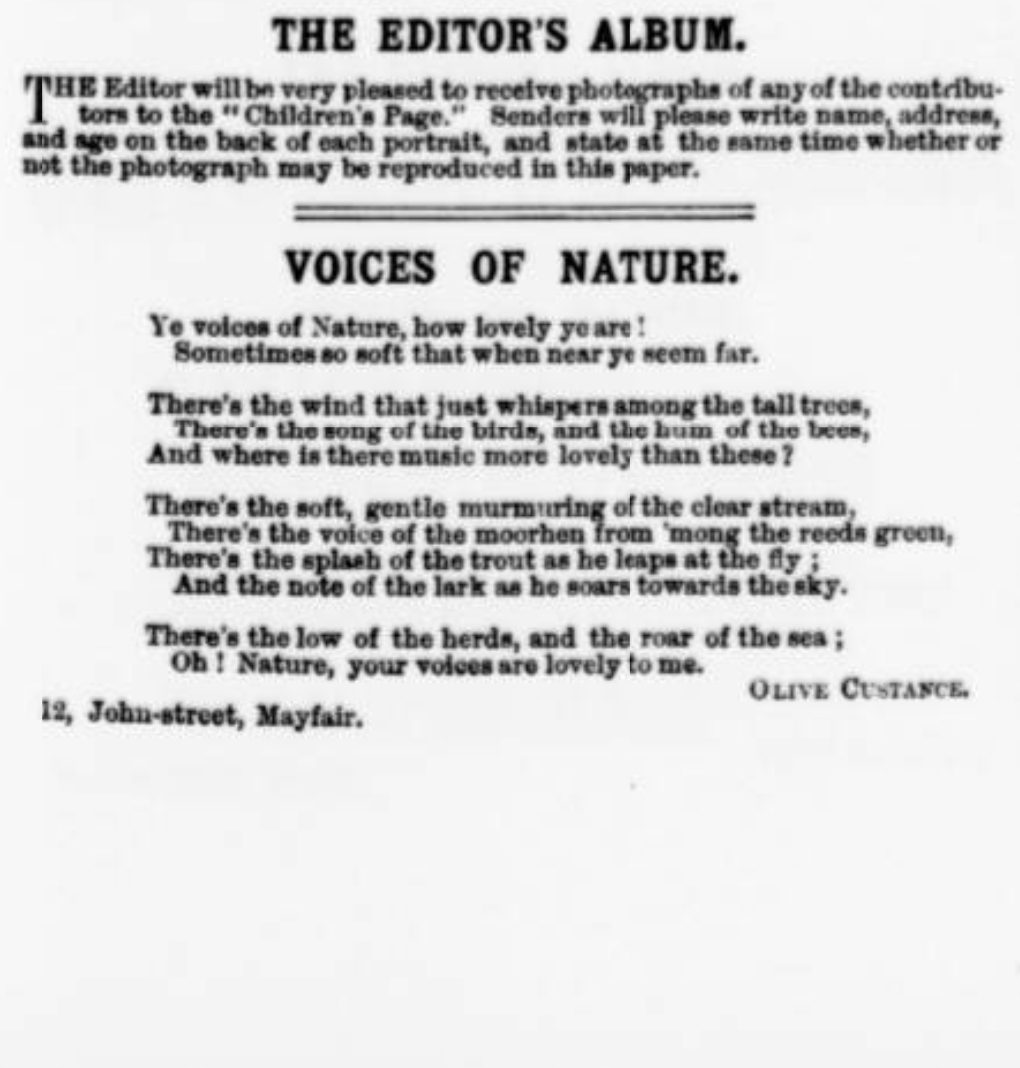
Encouraged by her mother, Olive began submitting poems to The Lady’s Pictorial in her early teens. Her first published work, Voices of Nature (1888), appeared with a brief editorial note praising her promise. This exchange began a routine of submission, comment, and revision. The editors’ advice was practical—“your writing has improved a little”—but their engagement provided her with a form of apprenticeship. The Lady’s Pictorial and The Gentlewoman offered a space where young women could learn the conventions of print culture, and Olive used it fully. Writing under her pseudonym “Wild Olive,” she gained confidence, learned editorial discipline, and began to see herself as a professional.

By the early 1890s she had travelled to France with family connections, improving her French and attending Mass regularly. Exposure to Catholic ritual and French literature deepened her sense of beauty as something sacred and disciplined rather than purely decorative. In her diary of 1895 she described Walter Pater’s Marius the Epicurean as a revelation, saying that it expressed her own soul in prose. It confirmed her belief that art and moral seriousness could coexist.

Returning to England, she moved in her mother’s social and artistic circles in Kensington and St John’s Wood. These contacts gave her access to editors and publishers, but she continued to rely on her own initiative and wrote furiously to newspapers seeking publication of her poems, and accepting any helpful advice she got back from Editors. Her father treated her literary interests with tolerant amusement, but her persistence was unmistakable.

Her chance came when The Pall Mall Magazine accepted The Parting Hour in 1895. The poem’s measured sentiment—“The sunset fades, and twilight grows apace, / The hour has come, my love, the parting hour”—and its accompanying illustration by J. Walter West perfectly suited the tastes of late-Victorian readers. Its success was immediate. The artwork featured on the Frontispiece. Remarkable for a girl of her age. Reprints appeared in newspapers across the English-speaking world, often with her name printed in bold. She was to become for a few years, one of the best-known young poets in Britain.

That success was not luck but the result of years of preparation. Through the discipline of the women’s press, she had developed technical skill, a sense of audience, and the confidence to present herself as a writer. Her upbringing, travel, and reading combined to form a distinctive voice: lyrical, restrained, and aware of beauty’s moral weight.

By the time her poem made her famous, Olive Custance was no longer an amateur. The years of practice behind her first success explain why she could step so easily into the literary world that awaited her. What looked like an effortless debut was the work of a decade spent learning her craft in private before her name reached print.

For the first time since he 1880s, we believe, here is Olive’s first ever published poem:

“Voices of Nature” – The Lady’s Pictorial, Saturday, 15 September 1888, p. 19
By Olive Custance (aged 14)

Ye voices of Nature, how lovely ye are!
Sometimes so soft that when near ye seem far.

There’s the wind that just whispers among the tall trees,
There’s the song of the birds, and the hum of the bees,
And where is there music more lovely than these?

There’s the soft, gentle murmuring of the clear stream,
There’s the voice of the moorhen from ’mong the reeds green,
There’s the splash of the trout as he leaps at the fly,
And the note of the lark as he soars towards the sky.

There’s the low of the herds, and the roar of the sea;
Oh! Nature, your voices are lovely to me.


References

  • The Lady’s Pictorial (issues from 1888–1894), featuring early poems and correspondence, often under the pseudonym “Wild Olive.”
  • The Gentlewoman (early 1890s), containing additional short verses and editorial comments.
  • Custance, Olive. Diary entries, circa 1895 (Berg Collection, New York Public Library).
  • The Pall Mall Magazine, May 1895: publication of The Parting Hour, with illustration by J. Walter West.
  • King, Edwin, (ed.), The Inn of Dreams: Poems by Olive Custance, St. Austin Press, 2015.
  • Adams, Jad. “Olive Custance: A Poet Crossing Boundaries,” English Literature in Transition, 1880–1920, vol. 61, no. 4 (2018), pp. 43–60.
  • Wintermans, Caspar. Alfred Douglas: A Poet’s Life and His Finest Work, 2007.
  • Hawkey, Nancy. Olive Custance Douglas: An Annotated Bibliography of Writings About Her, 1972.
  • McDermott, Ferdi. “Olive Custance: The Poison Pen of a Fairy Prince,” The Fortnightly Review, 23 April 2020.

Leave a comment

Filed under Uncategorized

Escape

Autumn woods, my heart is tired with wandering about 

And all my courage fails, 

O lovely woods draw close your coloured veils,

And shut the cold world out!

The little tangled branches catch my curls, the bracken makes

Strong nets to hold me fast,

But safe in Heaven my truant spirit makes 

Her bright wings free at last!

From Country Life, Vol. 46, Iss. 1194,  (Nov 22, 1919), p 649.

Leave a comment

Filed under Uncategorized

Bosie’s poison pen: new poems and research

Abstract

The relationship of Lord and Lady Alfred Douglas was stormy, but not private. An unpublished poem of Douglas’s described it as “Forever in the Press”, and their correspdonence and poetry continues to cast light on their unlikely, enduring union. This article includes significant, unpublished original work of Lord Alfred Douglas and Olive Custance, with the permission of the estate.

 The poison pen of the Fairy Prince. Available at:

https://fortnightlyreview.co.uk/2020/04/olive-custance/


Leave a comment

Filed under Uncategorized

“Peculiar flavor” and “preoccupation with the esoteric” … a 1950s view of Custance and friends

THE EIGHTEEN-NINETIES. A Period Anthology in Prose and Verse,
Chosen by Martin Secker. London: The Richards Press. p. xvi, 616.

(Review from the Dalhousie Review, Volume 32, Number 2, 1952)

This new edition of the Anthology first published in 1948, is another indication of the considerable revival of interest in the fin de siecle which has been evident during the past few years. This phenomenon in literary taste is probably due to reaction against much hasty and slovenly writing in an age of rage, pain and uncertainty.

The inner resources are once more being summoned-by the few, at least-as providing the only solace, the only verities. It is this unconscious quest for the felicity that comes with “. . . the cultivation of the self, the consolations of art”, as John Betjeman puts it in his Introduction, that identifies the modern reader with the writers of the period . “If we do not recognize the note of rebellion,- we will hear, those of us who can hear rhythm and rhyme, the accom- paniment of sound craftsmanship.” This is what is too often neglected by the critics of the Nineties. The revolt, the determination to shock, and the Victorian social climate which brought forth such lush and often over-exuberant manifestations being now vivid only to specialists, the often exquisite manner and matter of the writers of the day – all gone now, sadly, except Max Beerbohm – seem too often to have been overlooked. They are slowly earning acceptance once more. Certainly the spell is an entrancing one, and once it claims a happy victim, holds him fast. In the Introduction, Mr. ·Betjeman has slipped into the very polished periods of the decadence to tell of the publisher-compiler Martin Secker, worthy successor John Lane, and of the reading and sifting that finally resulted in this book.

Appropriately (and inevitably, to any lover of the period) the Dedication is to Sir Max Beerbohm. In Eighteen-Eighty and Diminuendo. selected from his writings, “The Incomparable Max” gives the flavor of an age as savoured by his bitter-sweet palate. As Hotbrook Jackson points out, the New Urbanity was finely exemplified in Max’s strangely modern personality, and one sees the decadence smiling at itself in his pages. ·

It appears that the arrangement of the selections is alphabetical by author and, therefore, it is only accidentally felicitous that Aubrey Beardsley should be first on the list. One has always been curious about Under the Hill, of course, and it is re-prin ted here. :Like a good many other things in this book, it is quite unobtainable and long out of print, and one has never seen it. Beardsley died early and this unfinished fragment is his only prose work. His amazing versatility is made apparent in this collection whose frontispiece is his illustration to The Three Musicians, which poem is also reproduced.

Beardsley may not have been essential to the period but he would have been out of place elsewhere and in his brief career he epitomized the courageous and often bizarre creative personality of the day. It was, as Max Beerbohm called it, ” … the Beardsley Period.” 

At times, the peculiar flavour of much Nineties writing becomes only too apparent. It reads almost as if Dawson, Olive Custance, Lord Alfred Douglas, Wilde and Beardsley were all one. The passion for close description of lush detail, of beauty grafted to elegance ; the preoccupation with the esoteric in all manner of luxurious trappings, outlandish sights and sounds and ‘scarlet’ sins, becomes mere posing at its worst. and most ingenious invention at its best.

But there is so much more here: George Moore, HenryHarland (editor of The Yellow Book), Arthur Symons (editor of The Savoy), Richard La Gallienne, perhaps most capable of evoking the true Nineties aura, as in A Ballad of London with its much-quoted ” … iron lilies of the Strand”. Here one will find also his exquisite, wonder-inspired Ode to Spring which is far from the Strand and patchouli and Bohemia. To browse through these pages is to come across many an example of the very special concern of the Nineties men with acute observation of externals and of the things of the mind. The long complete Lovers of Orelay of George Moore is quite typical prose in this sense, while Vincent O’Sullivan’s The Lady and Arthur Symons’ In Bohemia are poems which could, one might almost say, have been written at no other time.

This eloquent and elegant selection may well inspire the desire to write well, and if it does it will justify itself even beyond its inimitable period attraction. In the broader view, the attempt being made at the end of the last century to find a way for art in a bourgeois industrial society is still going on, and the contemplation of the earlier attempts makes the Nineties of real interest and importance to-day.

R. A. O’BRIEN 


Leave a comment

Filed under Uncategorized

Black Butterflies

O words of all my songs . . . black butterflies!
Wild words of all the wayward songs I sing . . .
Called from the tomb of some enchanted past
By that strange sphinx, my soul, they slowly rise
And settle on white pages wing to wing . . .
White pages like flower-petals fluttering
Held spellbound there till some blind hour shall bring
The perfect voice that, delicate and wise,
Shall set them free in fairyland at last!
That garden of all dreams and ecstasies
Where my soul sings through an eternal spring,
Watching alone with enigmatic eyes,
Dark wings on pale flower-petals quivering . . .
O words of all my songs . . . black butterflies!

Olive Custance

Leave a comment

Filed under Uncategorized

New biographical work on Custance

Review by Edwin James King

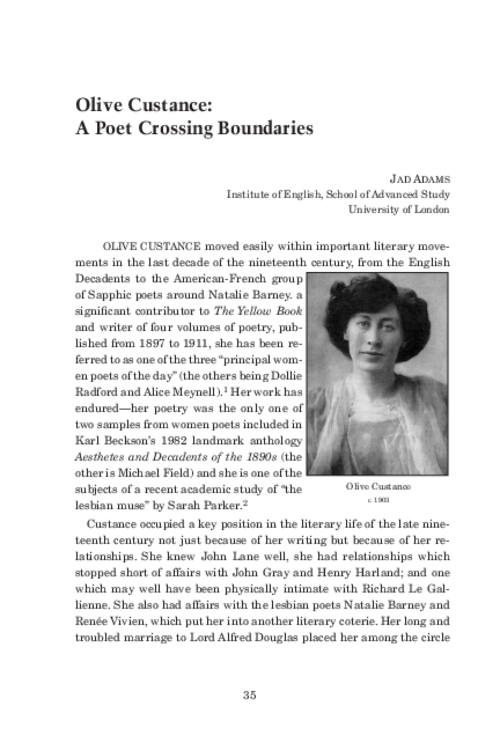
Adams, J. “Olive Custance: A Poet Crossing Boundaries.” English Literature in Transition, 1880-1920, vol. 61 no. 1, 2018, pp. 35-65. Project MUSE, muse.jhu.edu/article/679212.
olive

The British writer, historian and television producer Jad Adams has produced a extensively researched biographical account of Olive Custance. It is now, by a few hundred words,  the longest such work in print (the other two shorter ones are Father Sewell’s [1] and my own[2].) So I although I have to declare an interest, in the parliamentary sense of that term, I am perhaps as well-informed on the subject as I am opinionated, because I am deep in study of the same documents as Mr Adams. He is very much a confrère, rather than a competitor, so I hope he will not take any criticisms too much too heart. In this review I will explain why I enjoyed this article and why I also found it somewhat disappointing, at least as a biography of a poet.

Drawing largely on the work of various biographers of Lord Alfred Douglas and synthesising the information they give about Custance, Adams also gives some new information from the diaries in the Berg Collection in the New York Public Library and from letters in the Eccles Collection in the British Library. I have been looking at the London documents for a few years and have bought a ticket to New York to read the documents there in February 2018.  But I have also read documents from a few other places that Adams hasn’t visited (Oxford, British Columbia, Paris). It is not a level playing field … Adams is a scholar of a whole generation of writers so he cannot be everywhere at once; I am an Olive Custance fanatic and my main research focus is her and her alone.

One oft-neglected fact about Olive Custance is that most of the poetry that made her a celebrated figure of the ‘decadent’ 1890s was the work of girl of between 15 and 17 and not of a mature woman [3]. She was a well-read young girl with a lively imagination, fed by readings of Byron, Swinburne and Pater and artistic and sophisticated playacting with her younger sister, Cécile. She never went to school, but at 16 met the delicately handsome poet, John Gray, Oscar Wilde’s former intimate and future Catholic priest. She immediately fell in love with him, as her first ‘fairy prince’. In fact she fell in love with most of the really interesting people she met from then on (aided and abetted by a maid who enjoyed living and loving vicariously, rather like Juliet’s maid in Romeo and Juliet.) One of the young men was the poet and writer Richard Le Galienne, who believed she had the makings of a poet. Once her parents could be persuaded that she was old enough to be published (it took a few years), she turned out to be quite a hit. Her poems in the popular papers such as The Pall Mall Gazette reached a far wider audience than many of the serious-minded decadents and aesthetes whose handcrafted limited editions usually never ran to more than 200 copies and who rather disdained the mass market. She eventually married Lord Alfred Douglas, Oscar Wilde’s lover and her second ‘fairy prince’;  he was a better poet than she was, but neither he, nor John Gray, nor even Oscar Wilde enjoyed the worldwide attention of Olive Custance as a poet in the period known as the fin de siècle and the Edwardian era. In those days, Olive’s poems were read out during tens of thousands of peaceful family home evenings round the fire or the piano in places as far apart as London, Dublin, Kansas, Melbourne, Cape Town and Dehli; but today, of course, almost no one has heard of Olive Custance. She is known, if at all, as Oscar’s boyfriend’s wife.  That said, Adams’ work is part of a genuine revival. After the work of Nancy Hawkey[4] and Father Brocard Sewell in the 1970s there was a 40-year lull. But now, Olive Custance is coming out of the literary woodwork.

So what does Adams find in all those diaries and manuscripts? Unfortunately, the diaries do not cover her childhood or teenage years at all, and even the adult ones are often mutilated and incomplete.  This can lead to a great of deal of misconceptions, and also means one needs to do a lot of ‘joining up the dots’.  In general, Adams does this with an open mind, a strong sense of the cultural context and a deal of common sense. A breath of fresh air about her marriage, gleaned from the diaries, is that despite their complicated personalities, Bosie and Olive seem to have had a normal marital life; Adams makes a point of making a point about this because this truth has often been occluded by other writers, in their fascination for the theory that their married life was an impossible sham in sexual terms.

Adams gives more attention than has hitherto been given to Richard Le Gallienne, and this is encouraging; especially as the gossip at the time was that he and Olive had been lovers and yet scholars have for some reason tended to discount this. It all contributes to my impression that Le Gallienne was the man who was instrumental in making her reputation as a poet. Adams also seems to get all the complicated chronology around the courtship of Olive and Bosie completely right where other scholars have got muddled over it. (‘Bosie’ was the nickname of Lord Alfred Douglas, perhaps because he was “beau”.)

In regard to the poems themselves, Adams suggests that Custance was a poet who loved to bear her soul in verse, and yet most of the time he does not use her poems as a source for his biographical exposition; which is a pity as they cast a lot of light on her marriage, her beliefs, her priorities and her general outlook.  The only notable exception to this is when he makes a respectful nod to Dr Sarah Parker’s sapphic reading [5] of a number of poems. Nor does he speak much or at all about her style and development as a poet. In the end, although the account is informative and interesting, we are not left with any real impression of Custance as an artist.

There are also one or two biographical blind-spots that at the risk of seeming peevish, one feels it important to highlight. Apart from references to John Lane and the 1890s circle, we do not get a clear sense of the kind of society in which Olive grew up nor the company she kept in London later.

It is suggested that she grew up in the country, which is not quite true. The family only moved there properly when she was in her late teens, and it was in 1893 (when Olive was 19) that her father inherited the property at Weston Hall, Norfolk.  Before that time Eleanor (the mother), Cécile (born 1876) and Olive (born 1874) lived mainly in London, though no doubt many dreamy summer holidays were spent in Norfolk with their grandparents.  (The move to the country may in fact have had something to do with Colonel Custance’s disquiet about his eldest daughter’s social habits in the city.) The period covered by her published diary (1905-1910) [6] is not really covered much at all in the article, and her collections The Blue Bird (1905) and Inn of Dreams (1911) are ignored as life events and also for biographical clues they contain.

The continuing production of verses in the 20s, 30s and 40s, up to and including the Second World War, is not mentioned at all.  These gaps might not be important, but for the fact that we are only interested in her in the first place because she was a poet. Another lacuna is her conversion to Catholicism, which happened of her own accord when she was separated from her husband, and which had probably been in her mind for a long time. Such conversions were an important feature of the lives of a great many artistic people in those days, especially of ‘decadents’, so it is not an ephemeral detail. Although mention is made that at the time of her death she had lapsed, no previous mention is made of her conversion in 1917; nor is it mentioned that shortly before she died, she had expressed a desire to return to the Church.[7]  In general, although the correspondence now available does cast light on her life in the 20s and 30s, this is not adequately covered; especially as it included important and intriguing new friendships such as that with the famous Lord Leverhulme, the soap millionaire, and with the eccentric demonologist, Montague Summers. Marie Stopes is mentioned, and so is John Betjeman, but they were more friends of Bosie’s than of Olive’s.

The article is part of a larger and more ambitious project to provide extended biographical pieces about neglected ‘decadent women’ of the 1890s which will no doubt be brought together in a book in which some of what I have described as ‘gaps’ may well be filled. I have perhaps been a bit harsh in this review, but the context of the wider project perhaps puts the article’s shortcomings in perspective: Adams is mainly interested in Custance as a figure of the 1890s and it is therefore this period of her life which seems the most relevant and interesting, and the relationships of that period which seem to define her.

Father Sewell first expressed the view that Custance’s identification with decadence was nothing more than a pose; and other scholars have suggested that her labelling as a decadent is a mistake, caused simply by her intimate association with figures close to Oscar Wilde.  And yet the label sticks rather persistently. In 1920 Mary C. Sturgeon suggested that we “find in the verse of Olive Custance a complete devotion to beauty, and no other concern at all.” (Studies of Contemporary Poets, 1920, p. 402.) Based on a cursory reading of Opals and Rainbows, one can understand that opinion (even if it is an over-simplification), but even when read in a hurry the next two collections create a very different impression. Adams, however, is much rougher: “if enjoying art and sex without an apparent morality was decadent, then that is what she was.” For a real Olive Custance fan like me, that hurts. C’est trop, Monsieur Adams, c’est trop!

Walter Pater wrote in 1891 that “a true Epicureanism aims at a complete though harmonious development of man’s entire organism. To lose the moral sense therefore, for instance the sense of sin and righteousness, as Mr. Wilde’s heroes are bent on doing so speedily, as completely as they can, is … to become less complex, to pass from a higher to a lower degree of development.” [8] Olive Custance was more of Pater’s tribe than Wilde’s on the question of personal morality; few scholars pick this up.

So, although this new account fills some gaps in the picture, it leaves many still in need of attention, and unfortunately it fails to create an appetite to read the poetry for its own sake or for what it can tell us about the lady behind it. Olive wrote in 1905: “Like a shy child I bring you all my songs.”  The shy child, and her songs, still remain rather in the shadow of the men in her life. So there is plenty more work for people like Adams and me to do.

Edwin King published an edition of Custance’s Inn of Dreams in 2015 and is currently preparing Wild Olive: The Life and Collected Poems of Olive Custance (Lady Alfred Douglas) for publication in 2018.

Notes

[1] Brocard Sewell, Olive Custance: Her Life and Work (London: The 1890s Society, 1975).

[2] Olive Custance, Edwin James King (Ed.), The Inn of Dreams: Poems by Olive Custance, London: Saint Austin Press,  2015.)

[3] This is stated in a letter to AJ Symons, dated 27th November 1925, in the Norman Colbeck Collection, University of British Columbia Library, Canada.

[4] Nancy Hawkes, “Olive Custance Douglas: Introduction to a Bibliography” and “Olive Custance Douglas: An Annotated Bibliography of Writings About Her” in English Literature in Transition, 1880-1920, Volume 15, Number 1, 1972, pp. 49-51 and 52-56.

[5] Sarah Parker, The Lesbian Muse and Poetic Identity, 1889–1930 (London: Pickering and Chatto, 2013).

[6] Caspar Wintermans, I Desire the Moon: The Diary of Lady Alfred Douglas (Olive Custance), 1905–1910 (Woubrugge: The Avalon Press, 2004).

[7] Rupert Croft-Cooke, Bosie, (New York: Bobbs Merrill, 1963), p. 372.

[8] Walter Pater, ‘A Novel by Mr Oscar Wilde’, The Bookman, 1, Nov. 1891, pp.59-60; reprinted in Walter Pater: Sketches and Reviews (1919).

3 Comments

Filed under Uncategorized