Tag Archives: poems

Olive Custance, John Gray, and the Meaning of “Wild Olive”

Ferdi McDermott

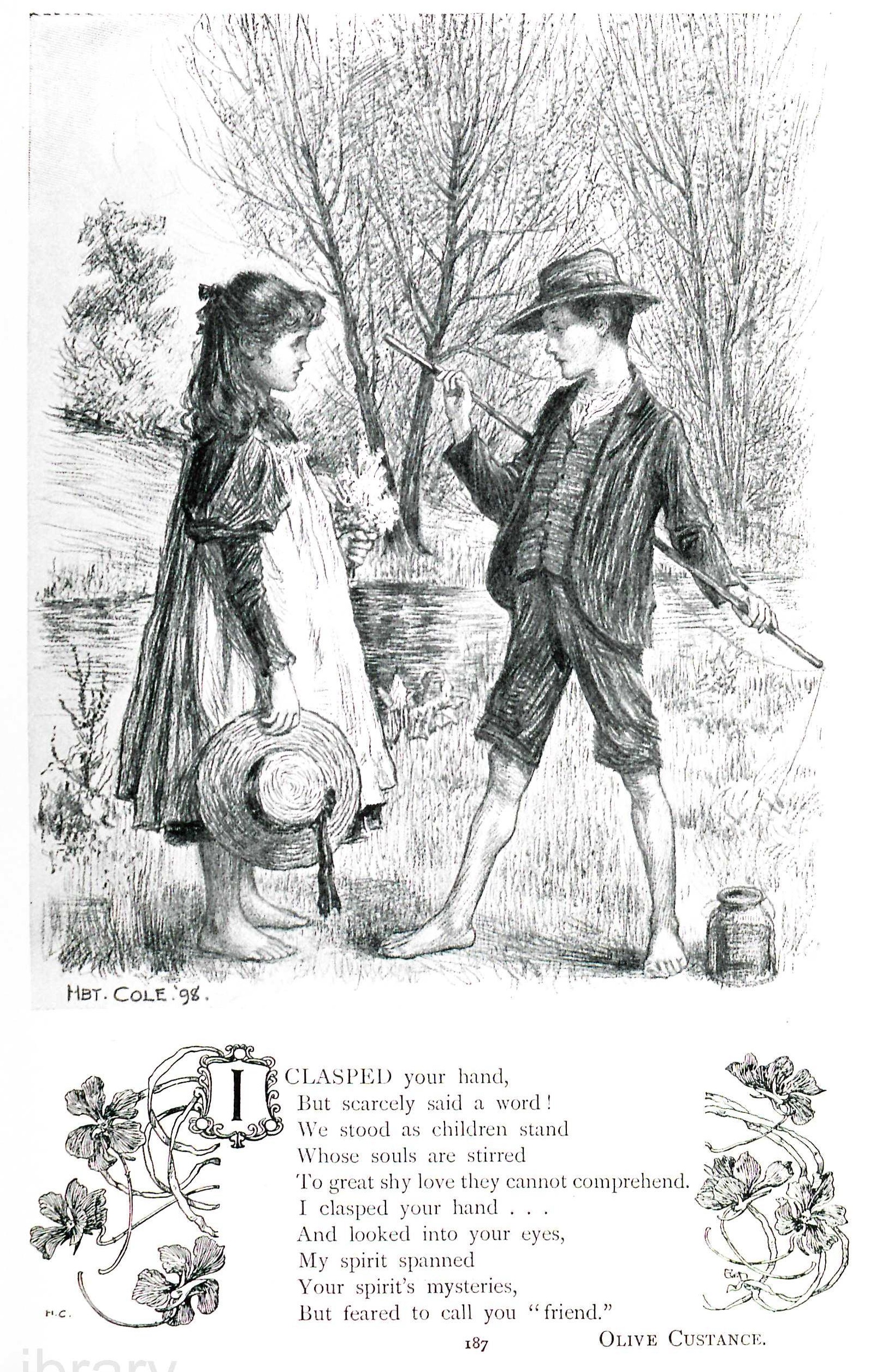
The brief encounter between Olive Custance and John Gray occupies a small but revealing place in the history of the 1890s. It shows not only the emotional openness of the young poetess but also the religious and aesthetic vocabulary she drew from her cultural milieu. Brocard Sewell’s In the Dorian Mode: A Life of John Gray, 1866–1934 (Padstow: Tabb House, 1983) remains the principal source for the episode, preserving the text of Olive’s diary and correspondence.

Sewell recounts that Olive, “a young society girl of aristocratic family,” met Gray “at a party” when she was about sixteen (c. 1890–91) and “fell in love with him at once.”1 “She must have been an extremely beautiful girl,” he adds, “and if only he had been attracted to her, her future life might have been happier.” Gray, ten years her senior, was courteous but unresponsive; nevertheless, he became for her “my ideal Poet.”

Her diary entries for 4 and 8 January 1896, quoted by Sewell, describe her joy in hearing from Gray and receiving Silverpoints:

“I had sent John Gray some of my poems, and the New Year brought a beautiful letter from him—and the photograph I so much desired and a book, Miracle Plays by K. Tynan Hinkson …”

“Then again next morning he came and brought me Silverpoints and was so kind and talked so beautifully—and looked so nice. He is my ideal Poet … and we were, I think, a happy little trio … But at last we all had to say goodbye—and he went home and sent me at once a lovely book and a charming little note.”

Two years earlier, at Christmas 1894, Olive had written from Weston, Norfolk, to a friend she calls “Lulu,” enclosing one of Gray’s privately printed Blue Calendars, little devotional booklets of verse. Her letter, quoted in full by Sewell, reveals both literary admiration and spiritual longing:

“Lulu, I send you a book and a song. For Christmas … A Poet—whom I once met as a child (I was about sixteen, and he was twenty-five)—wrote to me the other day and sent me his book—privately printed—of Carols on the life of the Christ Child. I think I may have spoken to you about him as he has been for a long while my Prince of Poets. There is not one who can sing like him—his poems are so precious and so pure … He has lived a strange full life and now he writes:

‘At a certain time one is apt to want to live for grace. Soon the better ideal comes—to live well and chance the grace. And is it not so with poetry? Have you come to the determination to write well at every risk—to put more fire into your work than anyone else could ever find out?’

Ever your loving WILD OLIVE.

Sewell described this as “the earliest use of the name Wild Olive,” observing that it expressed “both her youthful piety and her continuing fascination with the man she still called ‘my Prince of Poets.’”4 Later evidence, however, shows that Olive had adopted the name six years earlier, in 1888, when she was only fourteen. Several brief verses and letters signed “Wild Olive” appeared that year in The Lady’s Pictorial (London), showing that she had already fashioned a poetic persona from the phrase before ever meeting Gray.5 The 1894 letter thus represents not the creation but the revival and re-baptism of the name in a devotional key.

The Ruskinian Origin of “Wild Olive”

The term “Wild Olive” itself is drawn from John Ruskin, who used it repeatedly as a moral emblem. In Unto This Last (1860) and again in Ariadne Florentina (1876) and The Queen of the Air (1869), Ruskin contrasts the “wild olive” — the untamed human will — with the cultivated olive of peace and divine order:

“The wild olive is the type of man’s own wild will and intellect; but the tree of peace, the true olive, is planted only by the waters of obedience.”

For readers of the 1880s his phrase had a clear allegorical resonance: nature awaiting cultivation by grace. By adopting Wild Olive as her pen name, Olive Custance combined a literary pun on her Christian name with a Ruskinian emblem of the soul’s conversion from natural vitality to spiritual fruitfulness. In her later reuse of the signature, after meeting Gray, it came to symbolise precisely what she admired in him: the reconciliation of beauty with sanctity, art with faith.

Poems from the Episode

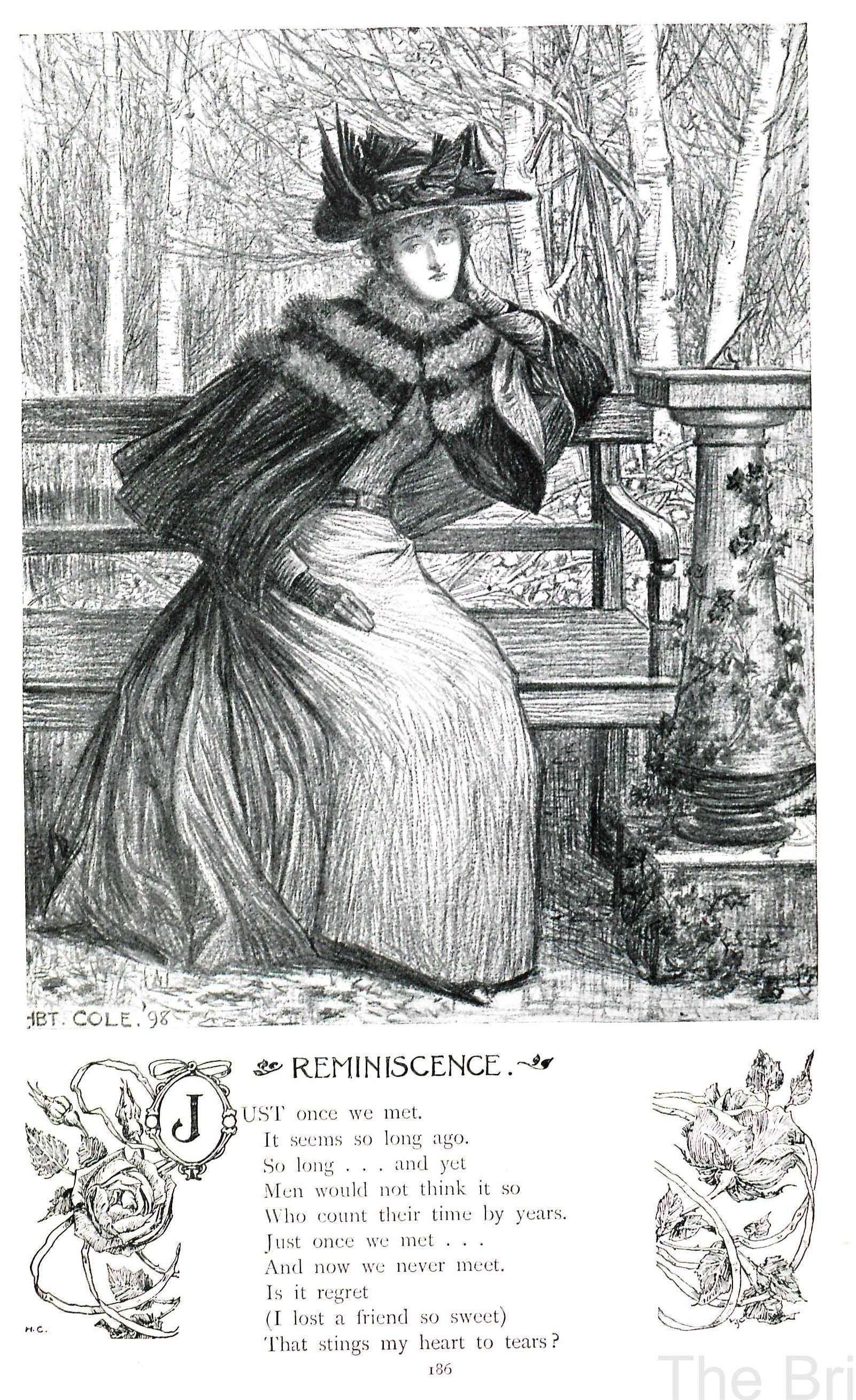
Two poems survive from this period of devotion. The first, “Reminiscences,” printed in Rainbows (London: John Lane, 1902, p. 29), looks back upon the long-past meeting: “Just once we met, / It seems so long ago …”.6

The second, “To John Gray,” was never included in her collections but was printed by Sewell from a manuscript now lost. Written probably between Opals (1897) and Rainbows (1902), it distils the same emotion in a more formal sonnet:

To John Gray
We are not sundered for we never met.
We only passed each other in the throng;
You were indifferent … and I may forget
Your profound eyes, your heavy hair, your voice
So clear, yet deep and low with tenderness,
That lingered on my ears like a caress
And roused my heart to make a futile choice.
O Poet that clamoured unto God in song!
How should I lose you thus and lack regret?
      

When, in 1898, Gray resolved to enter the Scots College in Rome to prepare for the priesthood, “among those who understood and approved his decision were Olive Custance and Lady Currie.”7 Thus, even after his retreat from literary society, Olive continued to venerate him, seeing in his conversion the fulfilment of the ideal she had already expressed through her Ruskinian pseudonym — the wild olive grafted into the true tree of peace.


References

  1. Brocard Sewell, In the Dorian Mode: A Life of John Gray, 1866–1934 (Padstow: Tabb House, 1983), p. 56.
    ↩︎
  2. Ibid., p. 57.
    ↩︎
  3. Ibid., p. 61.
    ↩︎
  4. Ibid.
    ↩︎
  5. See The Lady’s Pictorial (London), issues of 1888, where several short poems and letters by Olive Custance appear under the signature “Wild Olive.”
    ↩︎
  6. Olive Custance, Rainbows (London: John Lane, 1902), p. 29.
    ↩︎
  7. Sewell, In the Dorian Mode, p. 90.
    ↩︎

Leave a comment

Filed under Uncategorized

More early poems, 1888 onwards (aged 14)

BE CONTENT

The Lady’s Pictorial, c. 1890

I ask not for gold or for glory,
I seek not to be as they were,
The men of this world’s wondrous story—
Who fought and who conquer’d. Beware!
“Beware,” says my heart, “of aspiring, to heights which you cannot attain;
Beware! lest when fighting for greatness, you are clouded with sadness and shame.”

Beware! have you e’er seen the sparrow,
Try to mimic the nightingale’s song?
The place that you fill may be narrow,
And the longing you feel may be strong.
But remember, frail mortal, obedience, is the rule with the great; is it meant—
That He who has made us shall serve us? I tell you, not so, be content.

— OLIVE CUSTANCE

THE PASSING OF THE OLD YEAR

The Lady’s Pictorial, late 1880s – early 1890s
(Awarded a “Beautiful Fur Muff” from Messrs A. Perry & Co., Behring House, Argyll Street, W.)

Swish! the rain on the window-pane!
I have heard it over and over again;
A jarring note in the wind’s wild strain.

What has Life given in this last year
To mortal man, a smile – a tear?
Something to strive for, something to fear?
What did she leave in our soul’s way last?
Blossoming branches? or clouds that cast
Shadows lengthening out of the past?

What has she set in the garden ground
Of our roving thoughts? A mystic mound,
A grave that Memory circles round.

Like a shining stream, whose ceaseless fret
Over the stones that its course beset,
Vexes the heart that would fain forget!

No matter! the midnight and morn are wed,
The days Life enthroned and crown’d are dead!
The bells are dumb! and the Old Year fled!

I felt him pass, and knew as they met,
He laid his hand on the Young Year’s head.

— WILD OLIVE [Olive Custance]

’TIS AN AGE

(Letter-poem to the Editor)
The Lady’s Pictorial, c. 1888 – 89

Dear Mr. Editor,— ’Tis an age
Since I wrote to your charming “Children’s Page,”
And now, to make up, I’ll write in rhyme,
Though it’s rather hot work in the summer-time!

So I hope in return that you’ll print my letter,
Excusing all faults, for I can’t do better.
You see, praising flowers is more to my mind,
So what shall I put to make a rhyme find?

To-morrow we go to the country fair,
And I hope we’ll stay a long time there;
For I’ve two little dogs and a pony and chaise,
So I ought to be happy the livelong days.

And then I hope I shall write to you,
And sometimes send you some poetry too!
The last few days we’ve been packing – oh, dear!
I’m glad that the time is drawing near.

When smoky London we’ll leave and flee
Into the blooming country,
With its voices of birds and its many flowers,
With its fair green fields and its shady bowers.

Where the honeysuckle clings to the tree,
And noisily hums the bumble bee,
And a stream low-laughing creeps through the long grass
That eddies and wavers to let it pass.

For its limpid waters can scarce be seen,
So thick is the overhanging green.
But now, dear Editor, I must say,
For fancy is leading my thoughts astray;

So, hoping you’ll come to the country too,
I remain your friend, so loving and true,

— OLIVE CUSTANCE (aged 15)
12 John Street, Mayfair.

THE WAKING OF SPRING

The Gentlewoman, 1892 (“Children’s Salon”)
Reprinted later under the heading Poem by Lady Alfred Douglas

Spirit of Spring! Thy coverlet of snow
Hath fallen from thee with its fringe of frost,
And where the river late did overflow
Sway fragile white anemones, wind-tost,
And in the woods stand snowdrops half asleep
With drooping heads – sweet sisters so long lost.

Spirit, arise! for fair dawn flushes creep
Into the cold grey sky, where clouds assemble
To meet the sun, and earth hath ceased to weep.
Her tears tip every blade of grass and tremble,
Caught in the cup of every flower. O Spring!
I see thee spread thy pinions; they resemble

Large delicate leaves, all silver-vein’d, that fling
Frail floating shadows on the forest sward,
And all the birds about thee build and sing.
Blithe stranger from the gardens of our God,
We welcome thee, for One is at thy side
Whose voice is thrilling music, Love thy Lord,
Whose tender glances stir thy soul, whose wide
Wings wave above thee, thou awakened bride.

— OLIVE CUSTANCE (“Wild Olive”)

JOY

The Pall Mall Gazette, 11 May 1895

This wonderful wild winged thing
You cannot cage or keep!
No bodily eye has seen it.
You may have seen it in your sleep,
You must have heard it sing,
You must have felt its glory sweep
The shadow from some sorrow’s face,
In your soul’s secret place!

The light not sent from star or sun,
That shines in children’s eyes;
The laughter in your heart so sweet;
The sudden shimmering, soft surprise,
When Dawn’s gold web is spun:
All these from one rare rapture rise,
Whose fickle feet our hopes outrun,
Until Love’s crown is won!

For then this thing shall set our way
With splendid fire of flowers!
Stain blue our heaven,
String Earth’s slack’d harp with silver showers
Athwart Life’s summer day,
And smiling, put its hand in ours,
A-singing Joy that ne’er can stray,
As long as Love will stay!

— OLIVE CUSTANCE

Leave a comment

Filed under Uncategorized

Olive Custance’s Forgotten Childhood: the Making of a Poetess

Ferdi McDermott

When The Parting Hour appeared in May 1895, accompanied by a full-page illustration in The Pall Mall Magazine, it marked Olive Custance’s entry into public life. The poem was reprinted across Britain, the United States, and the colonies, appearing in newspapers from London to Sydney. Within weeks, her name was familiar to readers well beyond literary circles. Yet the sudden attention was the outcome of nearly ten years of steady work, reading, and correspondence.

Olive Eleanor Custance was born in London in 1874, the elder daughter of Colonel Frederick Custance of the 5th Lancers and Eleanor and Eleanor Custance (née Eleanor Constance Jolliffe). The family divided its life between the social world of St John’s Wood and the quiet of Weston, near Attleborough, Norfolk. Weston’s garden and fields gave her the imagery of her early poems: the recurring motifs of spring rain, lilac, and twilight that later appeared in Opals.

Her education was domestic. With her sister Cecil, she was taught by a Scottish governess, Tanie, who provided a balanced grounding in music, French, and moral discipline. Tanie’s calm authority and religious sensibility left a clear trace in Olive’s later poetry.

Encouraged by her mother, Olive began submitting poems to The Lady’s Pictorial in her early teens. Her first published work, Voices of Nature (1888), appeared with a brief editorial note praising her promise. This exchange began a routine of submission, comment, and revision. The editors’ advice was practical—“your writing has improved a little”—but their engagement provided her with a form of apprenticeship. The Lady’s Pictorial and The Gentlewoman offered a space where young women could learn the conventions of print culture, and Olive used it fully. Writing under her pseudonym “Wild Olive,” she gained confidence, learned editorial discipline, and began to see herself as a professional.

By the early 1890s she had travelled to France with family connections, improving her French and attending Mass regularly. Exposure to Catholic ritual and French literature deepened her sense of beauty as something sacred and disciplined rather than purely decorative. In her diary of 1895 she described Walter Pater’s Marius the Epicurean as a revelation, saying that it expressed her own soul in prose. It confirmed her belief that art and moral seriousness could coexist.

Returning to England, she moved in her mother’s social and artistic circles in Kensington and St John’s Wood. These contacts gave her access to editors and publishers, but she continued to rely on her own initiative and wrote furiously to newspapers seeking publication of her poems, and accepting any helpful advice she got back from Editors. Her father treated her literary interests with tolerant amusement, but her persistence was unmistakable.

Her chance came when The Pall Mall Magazine accepted The Parting Hour in 1895. The poem’s measured sentiment—“The sunset fades, and twilight grows apace, / The hour has come, my love, the parting hour”—and its accompanying illustration by J. Walter West perfectly suited the tastes of late-Victorian readers. Its success was immediate. The artwork featured on the Frontispiece. Remarkable for a girl of her age. Reprints appeared in newspapers across the English-speaking world, often with her name printed in bold. She was to become for a few years, one of the best-known young poets in Britain.

That success was not luck but the result of years of preparation. Through the discipline of the women’s press, she had developed technical skill, a sense of audience, and the confidence to present herself as a writer. Her upbringing, travel, and reading combined to form a distinctive voice: lyrical, restrained, and aware of beauty’s moral weight.

By the time her poem made her famous, Olive Custance was no longer an amateur. The years of practice behind her first success explain why she could step so easily into the literary world that awaited her. What looked like an effortless debut was the work of a decade spent learning her craft in private before her name reached print.

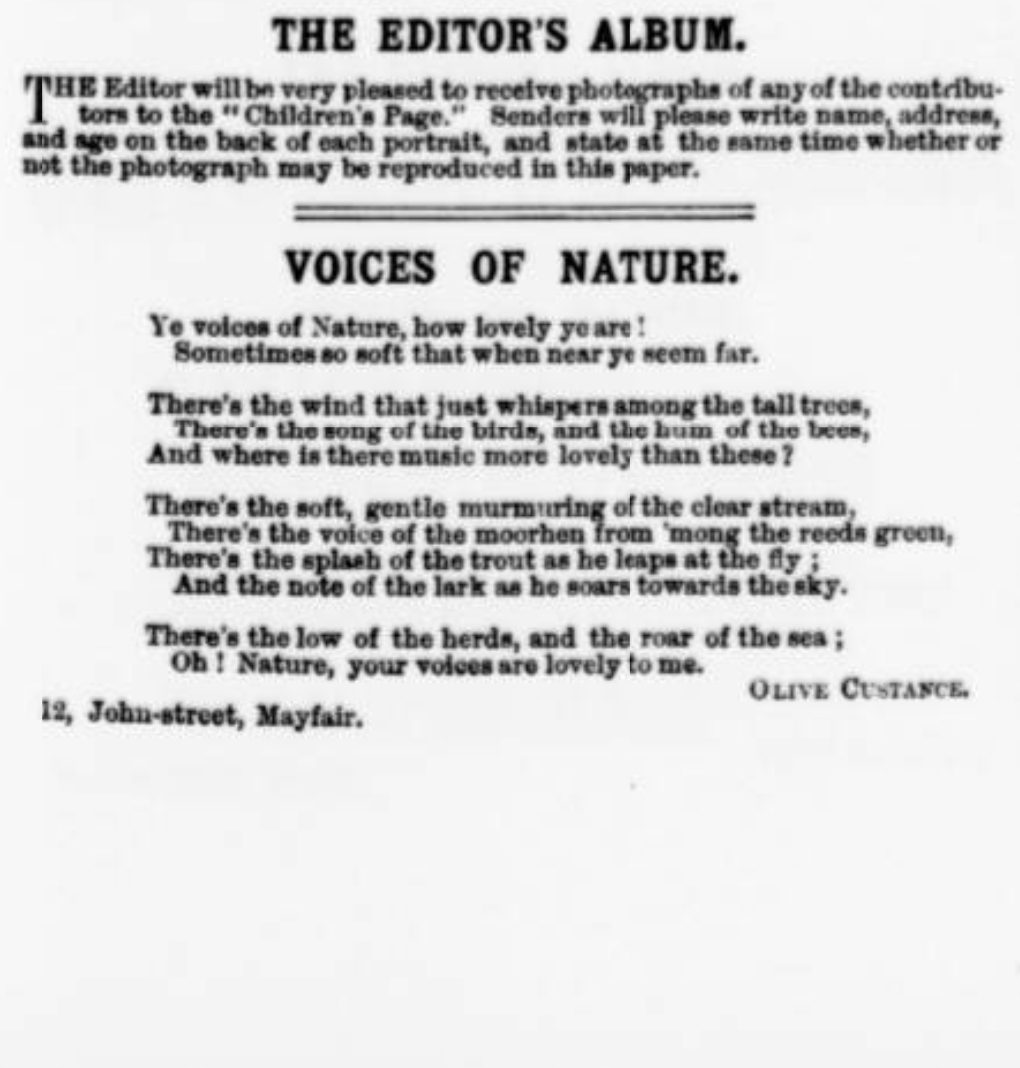
For the first time since he 1880s, we believe, here is Olive’s first ever published poem:

“Voices of Nature” – The Lady’s Pictorial, Saturday, 15 September 1888, p. 19
By Olive Custance (aged 14)

Ye voices of Nature, how lovely ye are!
Sometimes so soft that when near ye seem far.

There’s the wind that just whispers among the tall trees,
There’s the song of the birds, and the hum of the bees,
And where is there music more lovely than these?

There’s the soft, gentle murmuring of the clear stream,
There’s the voice of the moorhen from ’mong the reeds green,
There’s the splash of the trout as he leaps at the fly,
And the note of the lark as he soars towards the sky.

There’s the low of the herds, and the roar of the sea;
Oh! Nature, your voices are lovely to me.


References

  • The Lady’s Pictorial (issues from 1888–1894), featuring early poems and correspondence, often under the pseudonym “Wild Olive.”
  • The Gentlewoman (early 1890s), containing additional short verses and editorial comments.
  • Custance, Olive. Diary entries, circa 1895 (Berg Collection, New York Public Library).
  • The Pall Mall Magazine, May 1895: publication of The Parting Hour, with illustration by J. Walter West.
  • King, Edwin, (ed.), The Inn of Dreams: Poems by Olive Custance, St. Austin Press, 2015.
  • Adams, Jad. “Olive Custance: A Poet Crossing Boundaries,” English Literature in Transition, 1880–1920, vol. 61, no. 4 (2018), pp. 43–60.
  • Wintermans, Caspar. Alfred Douglas: A Poet’s Life and His Finest Work, 2007.
  • Hawkey, Nancy. Olive Custance Douglas: An Annotated Bibliography of Writings About Her, 1972.
  • McDermott, Ferdi. “Olive Custance: The Poison Pen of a Fairy Prince,” The Fortnightly Review, 23 April 2020.

Leave a comment

Filed under Uncategorized

Black Butterflies

O words of all my songs . . . black butterflies!
Wild words of all the wayward songs I sing . . .
Called from the tomb of some enchanted past
By that strange sphinx, my soul, they slowly rise
And settle on white pages wing to wing . . .
White pages like flower-petals fluttering
Held spellbound there till some blind hour shall bring
The perfect voice that, delicate and wise,
Shall set them free in fairyland at last!
That garden of all dreams and ecstasies
Where my soul sings through an eternal spring,
Watching alone with enigmatic eyes,
Dark wings on pale flower-petals quivering . . .
O words of all my songs . . . black butterflies!

Olive Custance

Leave a comment

Filed under Uncategorized

Primrose Hill

w_1200

Primrose Hill, photo from website of the Royal Parks.

Primrose Hill

Wild heart in me that frets and grieves,
Imprisoned here against your will . . .
Sad heart that dreams of rainbow wings
See! I have found some golden things!
The poplar trees on Primrose Hill
With all their shining play of leaves . . .

Proud London like a painted Queen,
Whose crown is heavy on her head . . .
City of sorrow and desire,
Under a sky of opal fire,
Amber and amethyst and red . . .
And how divine the day has been!
For every dawn God builds again
This world of beauty and of pain . . .

Wild heart that hungers for delight,
Imprisoned here against your will;
Sad heart, so eager to be gay!
Loving earth’s lovely things . . . the play
Of wind and leaves on Primrose Hill . . .
Or London dreaming of the night . . .
Adventurous heart, on beauty bent,
That only Heaven could quite content!

From The Inn of Dreams (1911)

Notes (by Edwin King)

In January 1908 the Douglases moved back to London, as Bosie (her husband) had taken up the editorship of The Academy. This was after a period in the country which her husband experienced as idyllic but during which Olive experienced frequent moments of isolation. Her diary shows that her social life took an upward turn. Their large home at 39, Fellows Road, Hampstead, near the idyllic Primrose Hill, combined the best of town and country. Olive still had little to do, but she could go for walks on the Hill, often with her little son Raymond.

Primrose Hill is a hill on the northern side of Regent’s Park in London, and is also the name given to the surrounding district. The hill has a clear view of central London to the south-east, as well as Belsize Park and Hampstead to the north. In the nineteenth century terraces of houses were built nearby for wealthy families. It has the aspect of a little village, very near the heart of London. A diary entry in August 1908 has Olive musing on the beauty of the scene and resolving to ‘make a poem’. The above poem is the fruit of that moment of inspiration.

Sitting on the hill, our poet is surprised to find some respite from London life. The poem is full of, by now, familiar themes : the poet’s own ‘wild heart’, the search for ‘golden things’, her love of nature, the burden of care, God’s gift of a golden new beginning every day.

Most striking of all is the line ‘Sad heart, so eager to be gay !’ which so poignantly sums up the poet’s quest. The last couplet recalls St Augustine, whom Custance must by now have read and taken to heart :

“Late have I loved thee, O Beauty ever ancient, ever new, late have I loved thee! Thou wert within me, but I was outside, and it was there that I searched for thee. In my unloveliness I plunged into the lovely things which thou didst create. Thou wert with me, but I was not with thee. Created things kept me from thee; yet if they had not been in thee they would have not been at all. Thou didst call, thou didst shout, and thou didst break through my deafness. Thou didst flash and shine, and didst dispel my blindness. Thou didst breathe thy fragrance on me; I drew in breath and now I pant for thee. I have tasted thee, now I hunger and thirst for more. Thou didst touch me, and I burned for thy peace …  Thou hast made us for thyself, O Lord, and our heart is restless until it rests in thee.” (St Augustine, Confessions)

Taken from The Inn of Dreams, edited by Edwin James King. https://www.amazon.co.uk/Inn-Dreams-Poems-Olive-Custance/dp/1901157695/

More information on Primrose Hill: https://www.royalparks.org.uk/parks/the-regents-park/things-to-see-and-do/primrose-hill

Leave a comment

Filed under Uncategorized

‘Daffodil Dawn’, ‘Beauty’ and ‘The Vision’

After ‘God took great roses, rare and pale’, here are three more poems evocative of the Virgin Mary. All three are taken from The Inn of Dreams, edited with notes, by Edwin King, 2015. (https://www.amazon.co.uk/Inn-Dreams-Poems-Olive-Custance/dp/1901157695/)

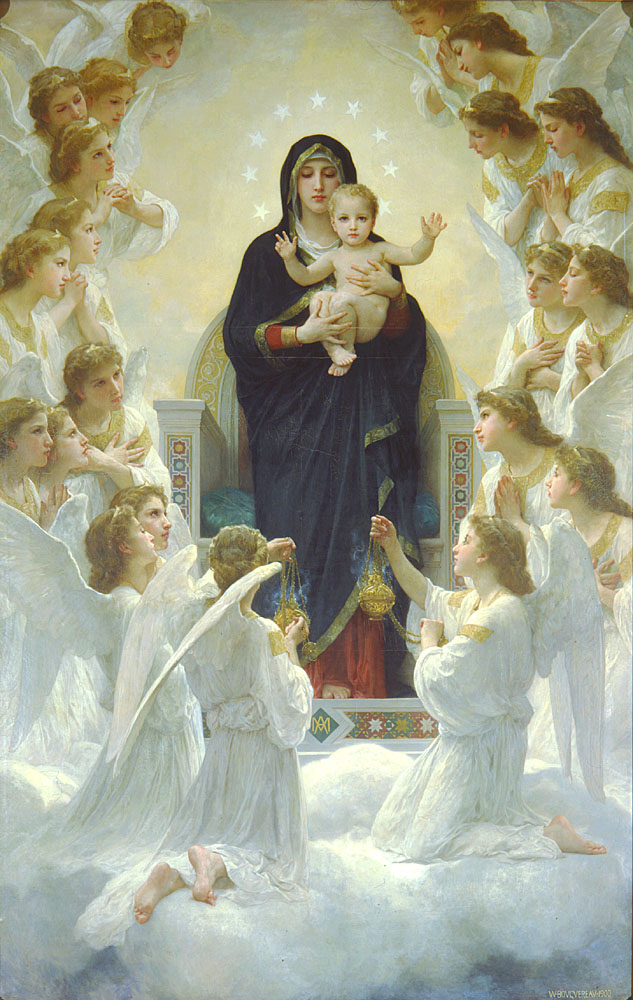
William_Adolphe_Bouguereau_Regina_Angelorum

The Virgin with Angels, c.1900 – William-Adolphe Bouguereau.

Daffodil Dawn

While I slept, and dreamed of you,
Morning, like a princess, came,
All in robe of palest blue:
Stooped and gathered in that hour
From the east a golden flower,
Great and shining flower of flame . . .
Then she hastened on her way
Singing over plain and hill–
While I slept and dreamed of you
Dreams that never can come true . .
Morning at the gates of Day,
Gathered Dawn, the daffodil!

Beauty

I saw the face of Beauty–a pale rose
In the gold dusk of her abundant hair . . .
A silken web of dreams and joys–a snare . .
A net of pleasures in a world of woes,
A bright temptation for gay youth that goes
Laughing upon his way without a care!
A shield of light for conquering Love to bear
Stronger than all the swords of all his foes.

O face of Beauty–O white dawn enshrined
In sunrise veils of splendid hair–O star!
Shine on those weary men who sadly wise
But guess thy glory faintly from afar–
Missing the marvel of thy smile–and blind
To the imperial passion in thine eyes!

The Vision

I come from lonely downs and silent woods,
With winter in my heart, a withered world,
A heavy weight of dark and sorrowful things,
And all my dreams spread out their rainbow wings,
And turn again to those bright solitudes
Where Beauty met me in a thousand moods,
And all her shining banners were unfurled . . .
And where I snatched from the sweet hands of Spring
A crystal cup and drank a mystic wine,
And walked alone a secret perfumed way,
And saw the glittering Angels at their play.
And heard the golden birds of Heaven sing,
And woke . . . to find white lilies clustering
And all the emerald wood an empty shrine,
Fragrant with myrrh and frankincense and spice,
And echoing yet the flutes of Paradise . . .


Notes, by Edwin King

Daffodil Dawn

It is unclear to whom the poem, first published in 1905 (in The Blue Bird), is addressed ; perhaps to her husband, perhaps to another man or woman for whom she feels a sexual desire to which she does not wish to succomb, because of her marriage commitment to Douglas and because of her moral principles. The sexual fantasies or dreams which the poetess at this time perhaps already had begun to think of as ‘impure thoughts’ disappear with the coming of the day.    Most likely the princess, draped in blue, is a reference to the Virgin Mary as well as to the dawning light. And perhaps the golden, fiery daffodil from the east is a spiritual gift to replace those ‘dreams that can never come true’.

Beauty

This poem, I am convinced, is placed deliberately after the one before it (Daffodil Dawn) for a clear, thematic reason:  Beauty is not just a celebration of feminine beauty; it takes the personification of the Dawn a step further, delicately suggesting the attractive power of the Virgin Mary. With the Catholic conversion of her husband, and with already nascent Catholic sympathies of her own, this must have been something Olive and Bosie had talked about together. In any case, the Virgin Mary had throughout the nineteenth century enjoyed a growing popularity among romantic poets, whether Catholic or not.

It is easy to fall into the trap of thinking the first stanza is speaking of the deceptive ‘snare’ of worldly beauty, waiting to trap us with is suffering and pain. We have certainly encountered this in other poems. But no, this would run completely counter to the prayer-like second stanza. The sense of the first stanza is surely that celestial beauty can in fact be every bit as seductive as that of the world, the flesh and the devil. This is all about a ‘star’ (Custance’s code for the philosophical or spiritual realm) who is at once terrifyingly seductive, martial (‘imperial’), glorious and kind (the ‘smile’).

Cf. ‘Song of Songs’ 6 : 10. “Who is she that cometh forth as the morning rising, fair as the moon, bright as the sun, terrible as an army set in battle array? ” (Applied by the Catholic liturgy to the Virgin Mary).

Regarding the ‘star’, the Virgin Mary, of course, is called Star of the Sea and Star of the Morning, in Catholic mystical poems and hymns.

The Vision

‘The Vision’ continues the themes of the previous two : Wordsworthian encounters with nature, lead to a series of more and more explicit meditations on Christian spirituality. First, capitalised ‘Beauty’, and the ‘Spring’ (the Virgin ?), ‘ a crystal cup … of mystic wine’ (intimation of Holy Communion and the Blood of Christ ?), ‘Angels at play’, ‘Heaven’ … and then, before it becomes too direct and obvious, our poetess awakes. But her benevolent feminine muse has left ‘white lilies’ (the traditional sign of the Virgin Mary’s purity) and lastly ‘myrrh and frankincense’ (two of the three gifts left with Mary by the three Wise Men for the baby Jesus. The other gift, gold, has already been given to the poetess in the poem Daffodil Dawn.) The wood has become a shrine … even if it is empty. Yet something still calls gently towards Faith : ‘echoing yet the flutes of Paradise.’ We are made to wonder : was it really just a dream ? The poem’s title suggests something more.

Leave a comment

Filed under Uncategorized

GOD TOOK GREAT ROSES RARE AND PALE

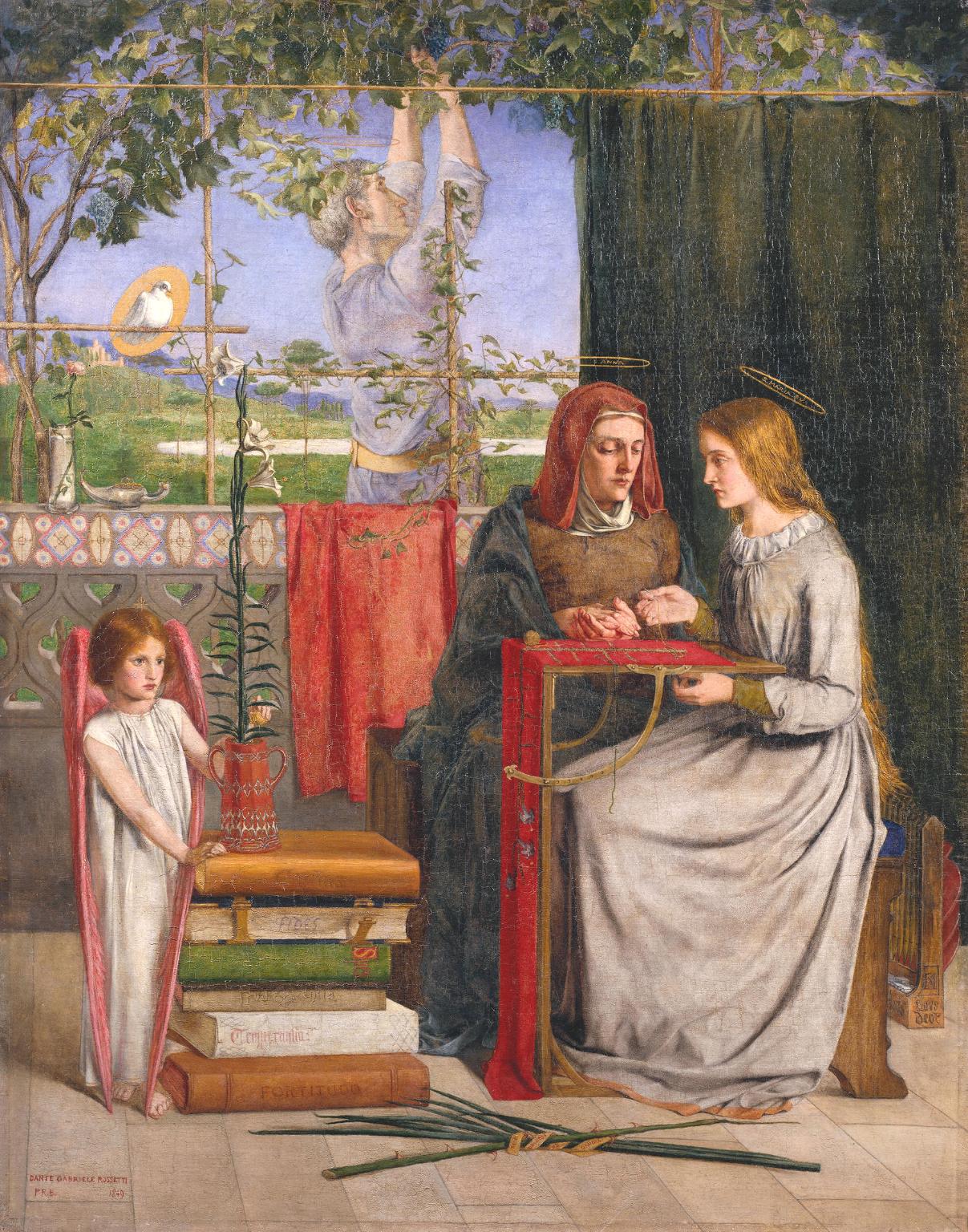
The Girlhood of Mary Virgin 1848-9 by Dante Gabriel Rossetti 1828-1882

The Girlhood of Mary Virgin 1848-9 by Dante Gabriel Rossetti 1828-1882.

‘But thine eyes are
As May skies are,
And thy words like spoken roses.’
SWINBURNE

GOD took great roses rare and pale,
And formed your body fair and frail ;
God took white violets cool and sweet,
And fashioned your small hands and feet ;
God took bright dust of gold and spun
Your soft hair, coloured like the sun ;
God made your clear and mystic eyes,
As blue as wild blue butterflies

Lady ! when as a child you played,
I think some angel all the while
With folded wings beside you stayed ;
You still remember her strange smile …
And when you say the simplest words,
The echo of her voice we hear . . .

And as across grey seas the birds
Fly after summer every year,
So our souls, when they hear you speak,
Straightway in search of heaven depart …
Or turning to your arms they seek
The angel hidden in your heart ! …

Leave a comment

Filed under Uncategorized

Reminiscence

rem-page-001rem-page-002

Leave a comment

Filed under Uncategorized

The Muse is the thing, wherein I’ll catch the conscience of the pageboy…

by Edwin King

Two  leading scholars

The two most prominent modern literary scholars to help give Olive Custance the attention she deserves are Patricia Pulham and Sarah Parker. Pulham’s focus is narrow, but well-argued. She is close to Custance’s poetics and is interested mainly in her themes and language. Parker is alive to the language too, but shows a keener interest in Custance’s life and personality. They both demonstrate a real appreciation of her work and offer some valuable new insights about her poems and her life. But they mainly focus on a very few of Custance’s poems: in Pulham’s case, the three poems dedicated to statues  – The White Statue, Statues and Antinoüs – and a few others dedicated to the male form more generally; in Parker’s case, the focus is on a number of poems, published and unpublished, that she feels shed light on the poet’s exploration of her sexuality.

Finding the muse

In Opals, her first collection, Custance (OC) addresses several poems to women, but also begins to develop the idea of a ‘Fairy Prince’ who becomes an important figure for her, even before she meets Lord Alfred Douglas. Once Lord Alfred Douglas (AD) is centre stage the girl muse is comprehensively displaced. These “muses” have become a focus for critical speculation for literary scholars, especially for Parker.

Beautiful girls and boys

Parker’s main point is that OC had settled on an imaginary ideal male muse even before she fell in love with AD; this was partly as a result – it is suggested – of her being strongly influenced by two important cultural writers of her day, Pater and Wilde, who both more or less clearly expressed the view that only boys could really be beautiful, and that love of the female form was a lesser love. This perspective did not gain much traction in Victorian society in general, where the icons of beauty for most people were the exquisite virgins of Waterhouse and Millais. But in the sphere of the decadents and aesthetes it achieved a certain dominance, precisely because of certain strong personalities who promoted this boy-centred idea. In some ways the circle of poets around John Lane in the 1890s acted as an echo chamber for Pater and Wilde, so Parker has a point.  There was certainly something in the air.  But Parker links a passage in Custance’s diary, in which she sees Walter Pater ascending to Heaven like a new Elijah, as evidence of Custance’s devotion to Pater’s homoerotic aesthetics.  I think that this is really jumping to gratuitous conclusions; Pater stood for more that this.

Could it be that what Custance was drawn to in Pater was his poetic vision? To his epicurean picture of life, where the artist’s role is to live to the full, gathering and celebrating the precious jewels of our existence, weaving them somehow into a tangible artistic reality, so that the poet provides a fixed point of meaning, “while all melts under our feet.” In this way, “we may well catch at any exquisite passion, or any contribution to knowledge that seems by a lifted horizon to set the spirit free for a moment, or any stirring of the senses, or work of the artist’s hands. Not to discriminate every moment some passionate attitude in those about us in the brilliancy of their gifts is, on this short day of frost and sun, to sleep before evening.” The objective, for Pater, is to produce a “quickened, multiplied consciousness” which gives the artistic soul a sense of stability and purpose. As a budding poet, Custance embraced this aesthetic vocation, desiring to “burn always with this hard, gem-like flame, to maintain this ecstasy”. (Pater, 1873.)

There is also a deep, spiritual element to Pater which helps to understand Custance and indeed many other figures of the fin de siècle. In 1885 Pater published a novel, about a very beautiful and extraordinarily sensitive youth who embarks on a search for truth, rather like St Augustine. He, and the novel, are called Marius the Epicurean; it is rarely mentioned nowadays, and that is for a number of reasons. First, Pater specifically intended Marius to be a way of correcting wrong – and worldly – interpretations of the ‘Conclusion’ to his 1873 book on the Renaissance; but perhaps mainly because Marius admires the life and teaching of the early Christians, seeing their philosophy as perpetuating the noblest of the old Roman beliefs. During the novel he moves from an appreciation for beauty to a kind of detachment, and then to the edge of belief in the Christian God. And at the point where he is ready to receive the gift of Faith, he dies. We know from her diaries that Olive Custance had previously read Marius the Epicurean, and on the death of Pater in 1894 had written in her diary that his spirit had “ascended to a fairer life” dressed in glorious golden robes, tainted with martyr’s blood. She saw him ascending to Heaven, like Marius, one surmises, that beautiful boy of his story.

Would it be out of order here to suggest a more obvious explanation for Custance’s boy muse? After all, practically all teenage girls have a picture of a kind of boy idol in their minds before they meet Mr Right? Don’t teenage boys do the same with fairytale princesses? Isn’t that why we tell them stories about beautiful princesses and handsome princes? And in the case of Olive, when we know Pater’s novel left such a profound spiritual impression on her, wasn’t she also looking for her Marius with whom she might make the journey of delight, leading, ultimately to a heavenward ascent?

New focus on Sappho

There is also the influence of Sappho to take into account, especially as since 1885, and  Henry Wharton’s new translation of her works,  the public became more aware of the same-sex attraction in some of her poetry.  But it is not completely clear that Custance was quite sure what this was all about.  She wanted to be like Sappho mainly because she wanted to be a great poet, as Sappho was. Like all girly girls, she was caught up in her own beauty and that of her girlfriends, while also looking forward to meeting her fairytale prince. It is true that Custance, after the publication of Opals in 1897, attracted attention and even fanmail, from female admirers, notably Natalie Barney and Renée Vivien who were attempting to gather a circle of women poets around them in Paris. But, in the end she rebuffed them all, and instead wooed Lord Alfred Douglas, by sending him fan-letters, praising his poetry and his looks.

Statues

Parker’s contention is that the focus on the male muse is a kind of compromise, especially when Custance is addressing her poems to statues.  Decadent male poets had liked to address male statues, in a kind of de-sexualised homoeroticism in which the coldness of marble cooled the transgressive passions …  Olive, it is suggested by Patricia Pulham, makes her male statues, opalescent, feminised … and so the androgynous boy becomes the ideal neutral territory, a safe object of worship for both boy-lovers and lesbians.

Of course the whole theme of statue-love is an old one, going back to Ovid’s character Pygamalion, and probably beyond.  And in general what such statues should be doing is to transform and enoble our aesthetic and romantic feelings, helping us see the potential for an epic, heroic and spiritual dimension to human beauty.

Inverting traditional roles?

Parker makes a lot of the notion that for a woman to write poetry in praise of the male  was an inversion of the traditional poetic relationship in which the woman is herself the muse for the male poet. Victoria Blain has already presented Elizabeth Barret Browning as somehow ground-breaking in her sonnets addressed to the male: “all of these sonnets retain their appeal not only for their subtle and tender expressions of love, but for their intriguing reversal of the standard poetic convention of a male poet addressing his female lover.”  (Blain, p. 44) Parker takes a similar line; more ground-breaking, a generation later … and Custance’s addressing of her poems to a boy instead of a girl is seen as a kind of ruse or compromise, and proof of her “queer” status. And yet, what, one wonders, would we make of Custance had all her poems been simply addressed to young girls, in order to respect “the standard poetic convention“?  In folk traditions, woman had always made this kind of poetry addressed to, or about, men (the waulking songs of the Gaelic women of the western isles are full of the praise of dashing young men); and as Douglas points out in his Autobiography we see it in Shakespeare; it is also in the Bible.

Even it is true, that in print female poets did not often risk male censure by straying into this territory, there are sufficient notable exceptions to show that there is nothing especially new in Barret’s Sonnets from the Portuguese or Custance in this regard; one could mention, for example, Emilia Lanier’s 17th century “Salve Rex Judaeorum” in which the poet praises the physical beauty of Christ on the Cross, with “his cheeks washed with milk”, his “curlèd locks/Black as a raven in her blackest hue/ His lips like scarlet threads, yet much more sweet”. A.L. Rowse calls this description “sensuous, not to say sexy” and far from seeing in it any sign of a transgressive sexuality, is touched that “for all her religiosity, it is nice to think that she was still responsive” to male beauty. (Rowse, 1978, p. 28).

The Prince and his Page

Parker also, with Pulham, makes much from the identification of OC with a Page boy and AD with a Prince.  This, we are led to believe, is more evidence of sexual confusion. The problem here is that if it is to be held that society viewed it as somehow unseemly for a woman to devote herself to a man in verse (as Parker suggests), then the ruse of adopting the guise of a pageboy, who could traditionally pledge his devotion to his master and enjoy a licence to intimacy with him (let us think, for example of Cesario – the disguised Viola – in Twelfth Night, who is only able to become intimate with Orsino, and openly declare her admiration for him, and receive his for her, because she is disguised as a page) is an obvious way out of the impasse. The ‘device’, for that is what it is, is well established in literature and culture. That OC is merely respecting a convention here, in a playful way, is easily demonstrated by a little lateral thinking: imagine if she had addressed AD as her Princess … not what would genuinely have been an inversion of roles. As is stands, it is not.

Women can love men in different ways

Women’s love poetry, as some of my pupils recently observed to me, tends to be more about depth of feeling and less about praise of the male beloved. And that has something to do with the way women love: they can often love a man who is older and less beautiful then they, whereas the first things a man looks for in a woman tend to be beauty and youth. And yet, when a woman does fall in love with a handsome man, it is perfectly natural that the sensual aspects of this love should come to the forefront of her love for him. Because of the great instinct towards reserve and modesty among women over the centuries, they are – it is true – often silent about the sensual beauty of their lovers. But mainly this is because women have been, as feminist scholars so frequently remind us, silent in general. (One of the greatest female poets of the nineteenth century Emily Dickinson, for example, published about a dozen poems in her lifetime, but another eighteen hundred were found in manuscript after her death.) So women who sing of a man in the way men often sing of women (praising their hair, their skin, their eyes, etc) are admittedly not very common. But these themes in Custance’s work do not, as Parker suggests, represent any particular ‘inversion’ of traditional roles.

As I have mentioned, in the Bible (Song of Songs), in the work of first published woman poet in English letters (Emilia Lanier), in Shakespeare and also in Douglas’s predecessors as a celebrity poet couple, the Brownings, we see time and time again, women for whom a young and handsome man is a perfectly proper muse.

To point out that taking a man as her muse in quite the way OC does was rare for her time is already stretching a point, but the assertion that heightened male eroticism in a woman poet is evidence of deep-seated lesbianism says more about the prevailing intellectual climate of this century that it does about anyone who lived in the last.

Bosie is an unreliable witness: let Olive tell her own story …

Parker refers this back to a single, much quoted passage in AD’s Autobiography, about his own sexuality and his wife’s, and uses this to suggest that AD became uncomfortable being the subject of OC’s poetic worship. She posits that his writing of his seven sonnets to her in 1907 was not so much an act of love as an act of male defiance and assertion of his masculinity. But this jars with the attitude expressed by AD in his Autobiography where he quotes, in quick succession, the adulatory letters of Olive to her ‘fairy prince’ and then one of his own Sonnets, and is obviously very proud of both. And in any case, most of the evidence that is produced is about the husband, not about the wife; and the testimony of Lord Alfred Douglas is notoriously unreliable and self-serving, as many of his biographers admit. As for those Sonnets, Olive at least accepted them delightedly at face value at the time, as tokens of deep and sincere love. Perhaps we should respect that.

With Parker’s approach to analysis of the poems, we get caught up in the old question of ‘ars specula vitae’ … is art reflecting life or life reflecting art and replaying those artistic tensions in real human relationships. My strong impression is that this analysis is just too precious. Much of Custance’s early poetry has little to do with her real life. It is just her charming  adolescent imagination at work – an imagination heavily influenced by her reading and environment, and yet a very fruitful one. As her real life takes over her mental energies, the poetic output diminishes, but the poems then certainly begin to provide a commentary on her lived experience.

Women seeking a voice

A lot of attention is given by modern scholars to the frustration of homosexuals (or at least ones of a literary bent) trying to find a voice in their society. And yet, despite the rise of feminism, not enough attention is given to the plight of middle and upper class women at the end of the nineteenth century, for whom frustration and suffocation, inside their corsets, had reached a ridiculous pitch. Forbidden from earning a living or looking after their own children, such women were beginning to seek a voice. They wanted to be ‘where it’s at’, they wanted to be up to date. Small wonder that to a certain extent they were led to despise some aspects of womanhood and femininity: they had first hand experience of how their situation as women held them back; voices like that of Pater must have been confusing, but compelling, because the prospect of a glamorous, artistic life, full of luxurious sensuality, might have seemed attractive to bored Victorian women. And yet once Pandora’s box was opened, women like Natalie Barney were able to see through the male homosexual artistic agenda that would replace heterosexual male hegemony with homosexual male hegemony, while the poor women missed their chance for liberation. (At least before women had been worshipped by poets, even if not given the vote!) Barney demolishes Pater’s suggestion that only a young man can be ultimately beautiful with the observation that boys are after all only beautiful because they look like women (speaking as Vally, in René Vivien’s roman à clef, Une Femme M’Apparut).

Byron, reflections and forced readings

In order to illustrate the way in which a preconceived idea can heavily colour our reading of a poem, I want to finish by mentioning one of the most glaring examples of Dr Parker’s imposing a forced reading on Custance’s verses. She makes a great deal of how dissolving into one’s beloved is somehow “narcissistic”, especially when one deploys the classic romantic image of being so close to the other that one sees oneself reflected in the eyes of the loved object; to my mind, the eyes are the window of the soul: so this implies the fusion of two kindred souls. The blurring of subject and object (who become one flesh, in biblical terms) is surely a primal aspect of the language of love.

And yet Parker claims that “mirror-images suggest the narcissism that was associated with both male and female homoerotic desire in the late nineteenth and early twentieth century: the Princess’ desire resides in the Prince’s ability to reflect her own beauty, [my italics] blurring the boundaries between self and other …  in the fifth and final poems of the sequence ‘Forget-Me-Nots’, the speaker values the beloved’s eyes for their reflective ability: ‘They see the sky like a looking glass'”.

All educated Victorian teenage girls were in love with Byron.  Germaine Greer suggests that he “was as conspicuous a figure as the multi-million-seller pop star would be today, and the most deeply affected segment of his readership was female.” (Reilly, p. xv.) So Olive, unsurprisingly, played ‘Childe Harolde’ with her little sister (Cecile, two years her junior, born in 1876)  as Ianthe, constituting the audience for Olive’s performances.  All middle and upper class teenage girls must surely have dressed up as men in childhood play (because women of their class did nothing interesting outside the home, thus severely limiting feminine dressing-up possibilities), and in any case in the Custance home, there were no boys; and Olive and Cecile never went to school. Parker, no doubt influenced by Custance’s diary accounts of her dressing up as Byron in childhood play, applies the same reasoning we have seen above applied to the poet in her twenties, to the teenage Olive: “A similar merging of self and other occurs in Custance’s unpublished poem ‘A Portrait of Lord Byron’, in which her identification with and desire for the male poet results in a narcissistic blurring of subject and object.” The poem in question begins “Oh, to have been a woman that he loved!” and Custance speaks of his strong slim hands  and divine great eyes, looking up into them to “see/A little wistful face reflected there.” (Parker, 2016, p. 90.) Much is made of Byron’s hands being slim and his eyes divine, as if that makes him effeminate. No mention is made of the fact that each adjective is paired with a more masculine one: strong and great.

What she perhaps loses sight of is that this poem of adulation is quite simply an expression of love composed by a very ‘girly’ teenage girl gazing at a portrait of her dashing, male heart-throb: nothing more, nothing less.

And the subsequent developments in her muse provide a kind of illustration of a woman, rather slowly and reluctantly, growing up.

The older Olive reminds us a great deal of the early 17th century Emilia Lanier, a mature woman, used and abused by men, falling back in mature years on the love that trumps all the others. Olive Custance, like Emilia Lanier, tried and tested by real love and the sufferings it brought her, ultimately addresses her songs not to other girls, nor to their brothers, but to Christ and his mother.

Custance speaks of her youthful self in the first poem in her last collection, The Inn of Dreams, and while still enjoying the sensual pleasures with her fairy princes, she simultaneously hopes or prays that one day, when her youth has left her, Love will come by, weeping to see her lonely, and take pity on her. In The Changeling she dreams of it too:

My spirit is a homing dove . . . [1]
I drain a crystal cup, and fall
Softly into the arms of Love . . .
And then the darkness covers all.

And in The Wings of Fortune, we see this happen even more definitively, when Christ, coming to her as a beautiful young man[2], throws away his crown of thorns; and like a second Orpheus, sings his love song to Olive’s weary soul and lifts her from death, once more young and radiant.

__________________________________

[1] Heading for Heaven, no doubt.

[2] This is my reading of the phrase ‘Love the boy’

Works cited or mentioned:

  • Blain, Virginia (2001), Victorian Women Poets: An Annotated Anthology.
  • Parker, Sarah (2011). ‘”A Girl’s Love”: Lord Alfred Douglas as Homoerotic Muse in the Poetry of Olive Custance’”, Women: A Cultural Review 22 (2-3): 220-240.
  • Parker, Sarah (2016). “Olive Custance,” The Lesbian Muse and Poetic Identity, 1889–1930, Pickering & Chatto, pp. 71–100.
  • Pater, Walter (1873),”Conclusion”, Studies in the History of the Renaissance.
  • Pater, Walter (1885), Marius the Epicurean.
  • Pulham, Patricia (2007). “Tinted and Tainted Love: The Sculptural Body In Olive Custance’s Poetry”; The Yearbook of English Studies, Jan 1, 2007.
  • Reilly, Catherine, ed. (1994) Winged Words: Victorian Women’s Poetry and Verse
  • Rowe, A.L. (1978), The Poems of Shakespeare’s Dark Lady.
  • Vivien, Renée (1904), Une Femme M’Apparut.

 

Leave a comment

Filed under Uncategorized

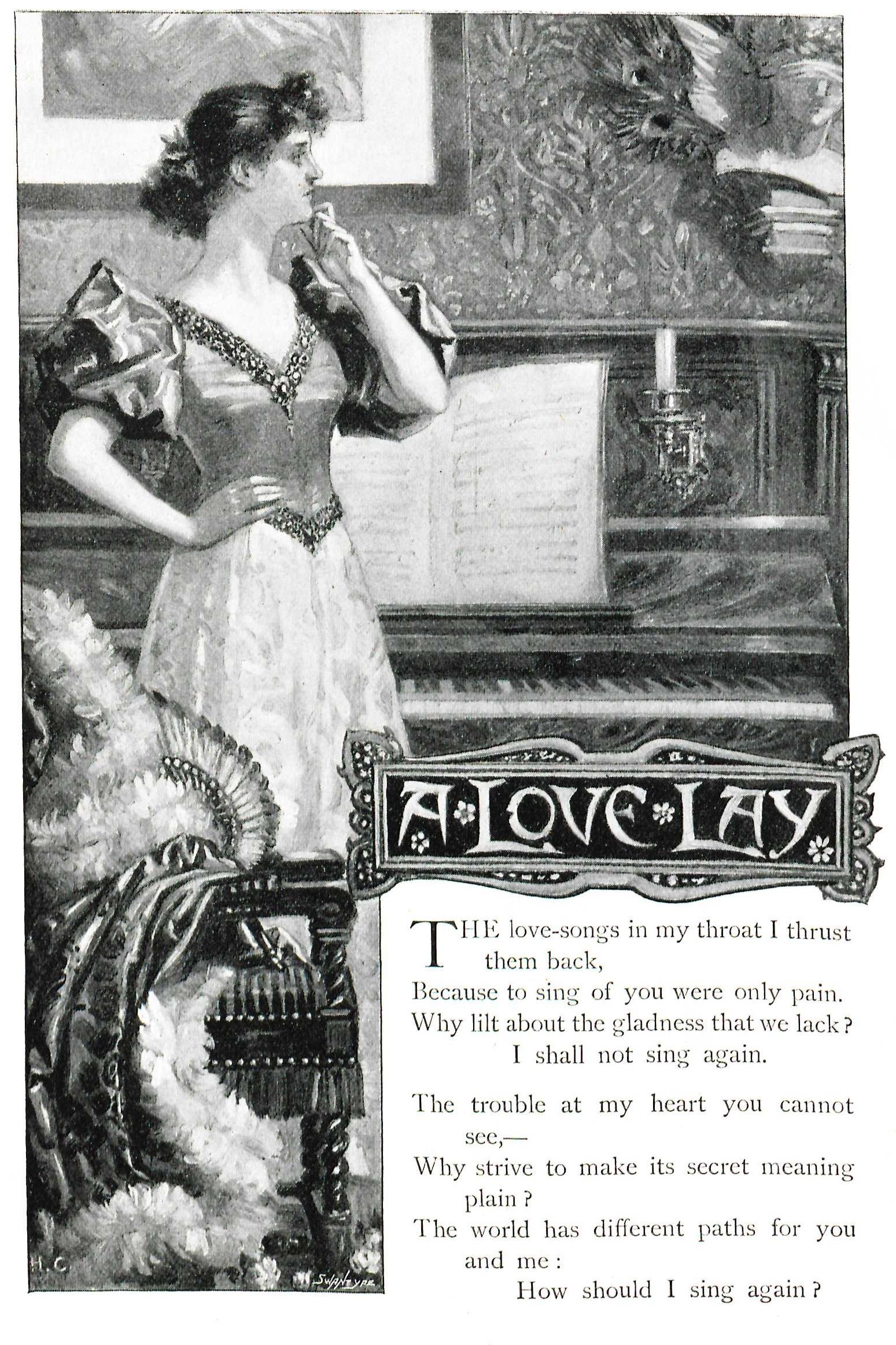
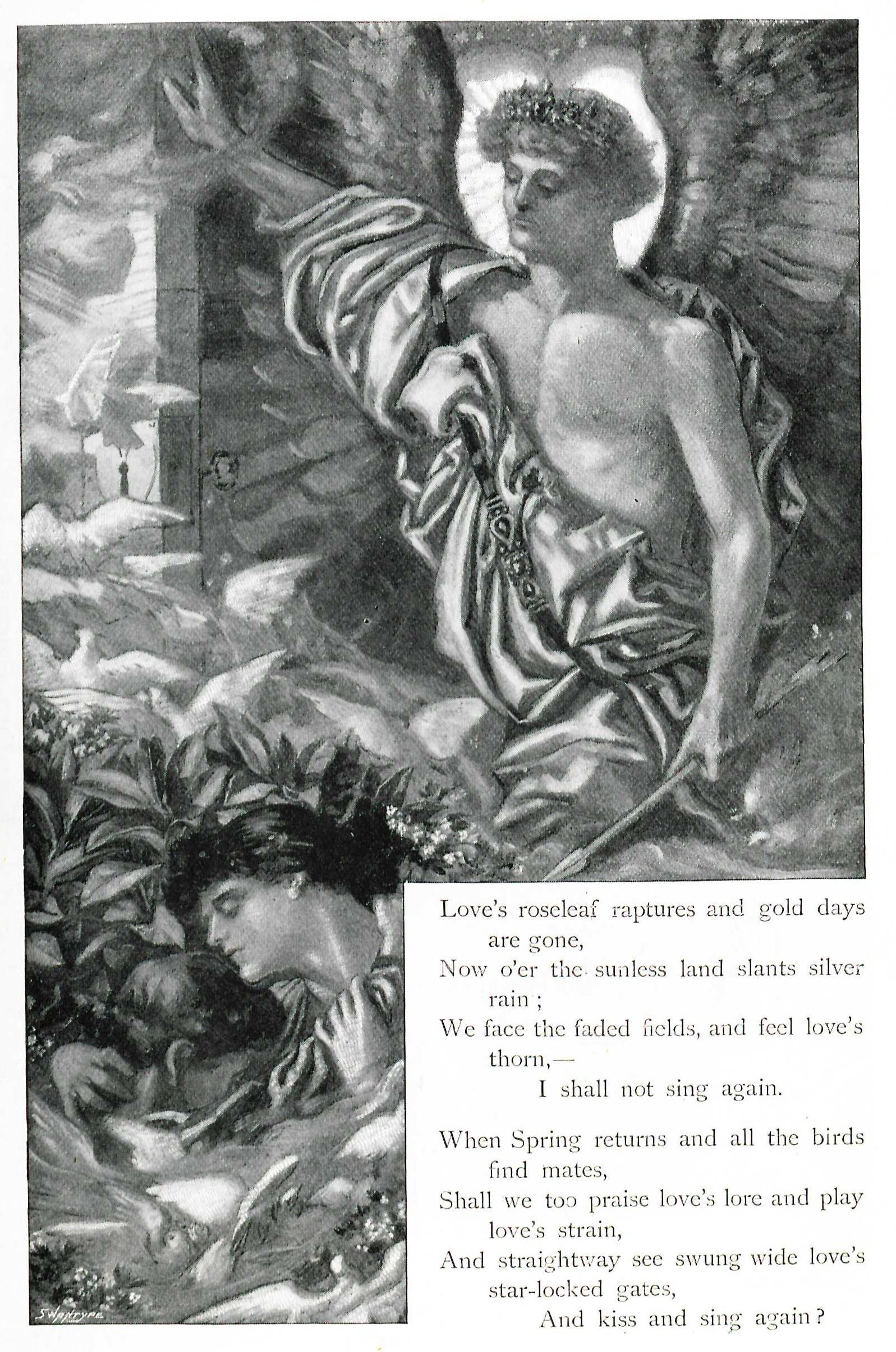
A Love Lay

lovelay1lovelay2from The Pall Mall Magazine June, 1896.

Leave a comment

December 2, 2017 · 1:56 pm