Tag Archives: writing

Olive Custance, John Gray, and the Meaning of “Wild Olive”

Ferdi McDermott

The brief encounter between Olive Custance and John Gray occupies a small but revealing place in the history of the 1890s. It shows not only the emotional openness of the young poetess but also the religious and aesthetic vocabulary she drew from her cultural milieu. Brocard Sewell’s In the Dorian Mode: A Life of John Gray, 1866–1934 (Padstow: Tabb House, 1983) remains the principal source for the episode, preserving the text of Olive’s diary and correspondence.

Sewell recounts that Olive, “a young society girl of aristocratic family,” met Gray “at a party” when she was about sixteen (c. 1890–91) and “fell in love with him at once.”1 “She must have been an extremely beautiful girl,” he adds, “and if only he had been attracted to her, her future life might have been happier.” Gray, ten years her senior, was courteous but unresponsive; nevertheless, he became for her “my ideal Poet.”

Her diary entries for 4 and 8 January 1896, quoted by Sewell, describe her joy in hearing from Gray and receiving Silverpoints:

“I had sent John Gray some of my poems, and the New Year brought a beautiful letter from him—and the photograph I so much desired and a book, Miracle Plays by K. Tynan Hinkson …”

“Then again next morning he came and brought me Silverpoints and was so kind and talked so beautifully—and looked so nice. He is my ideal Poet … and we were, I think, a happy little trio … But at last we all had to say goodbye—and he went home and sent me at once a lovely book and a charming little note.”

Two years earlier, at Christmas 1894, Olive had written from Weston, Norfolk, to a friend she calls “Lulu,” enclosing one of Gray’s privately printed Blue Calendars, little devotional booklets of verse. Her letter, quoted in full by Sewell, reveals both literary admiration and spiritual longing:

“Lulu, I send you a book and a song. For Christmas … A Poet—whom I once met as a child (I was about sixteen, and he was twenty-five)—wrote to me the other day and sent me his book—privately printed—of Carols on the life of the Christ Child. I think I may have spoken to you about him as he has been for a long while my Prince of Poets. There is not one who can sing like him—his poems are so precious and so pure … He has lived a strange full life and now he writes:

‘At a certain time one is apt to want to live for grace. Soon the better ideal comes—to live well and chance the grace. And is it not so with poetry? Have you come to the determination to write well at every risk—to put more fire into your work than anyone else could ever find out?’

Ever your loving WILD OLIVE.

Sewell described this as “the earliest use of the name Wild Olive,” observing that it expressed “both her youthful piety and her continuing fascination with the man she still called ‘my Prince of Poets.’”4 Later evidence, however, shows that Olive had adopted the name six years earlier, in 1888, when she was only fourteen. Several brief verses and letters signed “Wild Olive” appeared that year in The Lady’s Pictorial (London), showing that she had already fashioned a poetic persona from the phrase before ever meeting Gray.5 The 1894 letter thus represents not the creation but the revival and re-baptism of the name in a devotional key.

The Ruskinian Origin of “Wild Olive”

The term “Wild Olive” itself is drawn from John Ruskin, who used it repeatedly as a moral emblem. In Unto This Last (1860) and again in Ariadne Florentina (1876) and The Queen of the Air (1869), Ruskin contrasts the “wild olive” — the untamed human will — with the cultivated olive of peace and divine order:

“The wild olive is the type of man’s own wild will and intellect; but the tree of peace, the true olive, is planted only by the waters of obedience.”

For readers of the 1880s his phrase had a clear allegorical resonance: nature awaiting cultivation by grace. By adopting Wild Olive as her pen name, Olive Custance combined a literary pun on her Christian name with a Ruskinian emblem of the soul’s conversion from natural vitality to spiritual fruitfulness. In her later reuse of the signature, after meeting Gray, it came to symbolise precisely what she admired in him: the reconciliation of beauty with sanctity, art with faith.

Poems from the Episode

Two poems survive from this period of devotion. The first, “Reminiscences,” printed in Rainbows (London: John Lane, 1902, p. 29), looks back upon the long-past meeting: “Just once we met, / It seems so long ago …”.6

The second, “To John Gray,” was never included in her collections but was printed by Sewell from a manuscript now lost. Written probably between Opals (1897) and Rainbows (1902), it distils the same emotion in a more formal sonnet:

To John Gray
We are not sundered for we never met.
We only passed each other in the throng;
You were indifferent … and I may forget
Your profound eyes, your heavy hair, your voice
So clear, yet deep and low with tenderness,
That lingered on my ears like a caress
And roused my heart to make a futile choice.
O Poet that clamoured unto God in song!
How should I lose you thus and lack regret?
      

When, in 1898, Gray resolved to enter the Scots College in Rome to prepare for the priesthood, “among those who understood and approved his decision were Olive Custance and Lady Currie.”7 Thus, even after his retreat from literary society, Olive continued to venerate him, seeing in his conversion the fulfilment of the ideal she had already expressed through her Ruskinian pseudonym — the wild olive grafted into the true tree of peace.


References

  1. Brocard Sewell, In the Dorian Mode: A Life of John Gray, 1866–1934 (Padstow: Tabb House, 1983), p. 56.
    ↩︎
  2. Ibid., p. 57.
    ↩︎
  3. Ibid., p. 61.
    ↩︎
  4. Ibid.
    ↩︎
  5. See The Lady’s Pictorial (London), issues of 1888, where several short poems and letters by Olive Custance appear under the signature “Wild Olive.”
    ↩︎
  6. Olive Custance, Rainbows (London: John Lane, 1902), p. 29.
    ↩︎
  7. Sewell, In the Dorian Mode, p. 90.
    ↩︎

Leave a comment

Filed under Uncategorized

Olive Custance’s Forgotten Childhood: the Making of a Poetess

Ferdi McDermott

When The Parting Hour appeared in May 1895, accompanied by a full-page illustration in The Pall Mall Magazine, it marked Olive Custance’s entry into public life. The poem was reprinted across Britain, the United States, and the colonies, appearing in newspapers from London to Sydney. Within weeks, her name was familiar to readers well beyond literary circles. Yet the sudden attention was the outcome of nearly ten years of steady work, reading, and correspondence.

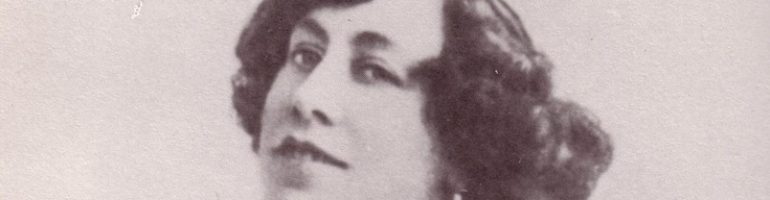
Olive Eleanor Custance was born in London in 1874, the elder daughter of Colonel Frederick Custance of the 5th Lancers and Eleanor and Eleanor Custance (née Eleanor Constance Jolliffe). The family divided its life between the social world of St John’s Wood and the quiet of Weston, near Attleborough, Norfolk. Weston’s garden and fields gave her the imagery of her early poems: the recurring motifs of spring rain, lilac, and twilight that later appeared in Opals.

Her education was domestic. With her sister Cecil, she was taught by a Scottish governess, Tanie, who provided a balanced grounding in music, French, and moral discipline. Tanie’s calm authority and religious sensibility left a clear trace in Olive’s later poetry.

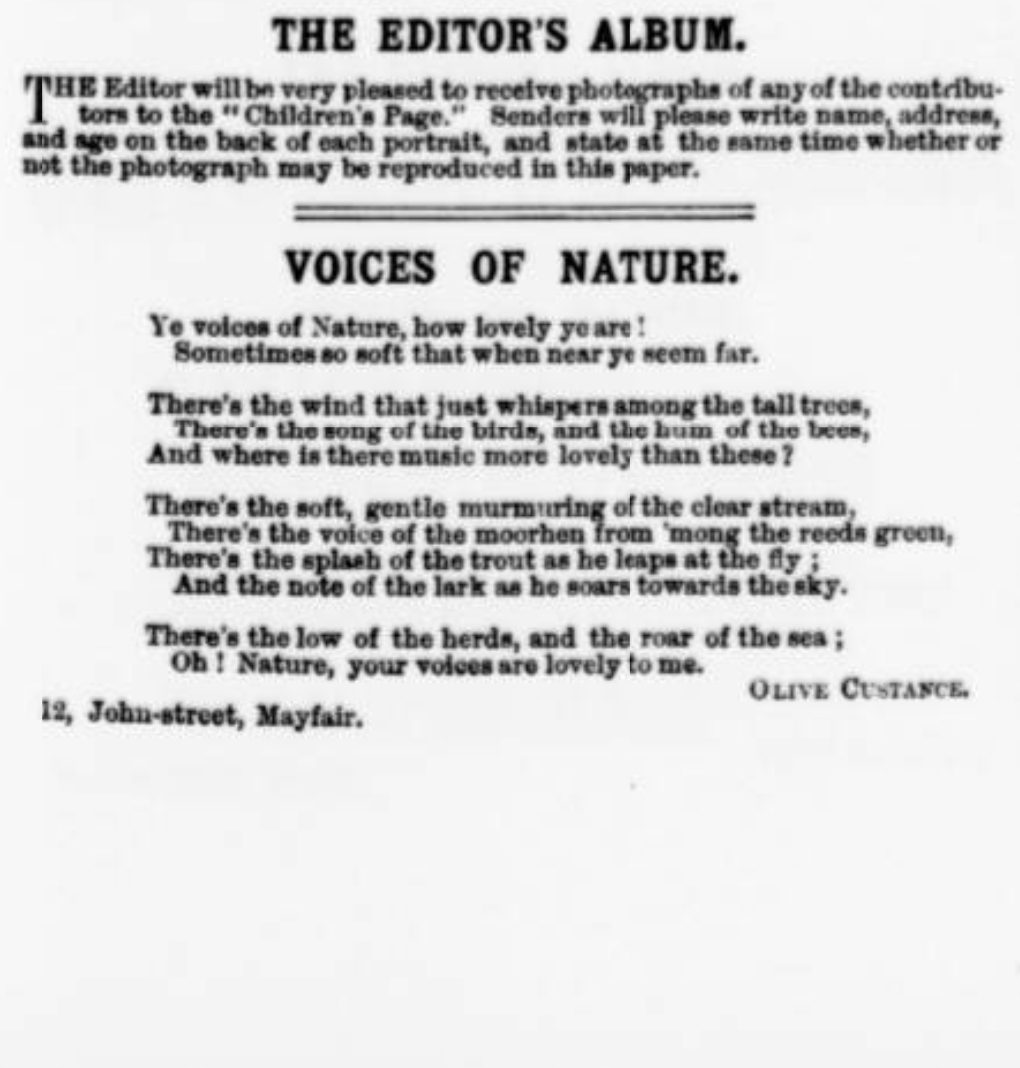
Encouraged by her mother, Olive began submitting poems to The Lady’s Pictorial in her early teens. Her first published work, Voices of Nature (1888), appeared with a brief editorial note praising her promise. This exchange began a routine of submission, comment, and revision. The editors’ advice was practical—“your writing has improved a little”—but their engagement provided her with a form of apprenticeship. The Lady’s Pictorial and The Gentlewoman offered a space where young women could learn the conventions of print culture, and Olive used it fully. Writing under her pseudonym “Wild Olive,” she gained confidence, learned editorial discipline, and began to see herself as a professional.

By the early 1890s she had travelled to France with family connections, improving her French and attending Mass regularly. Exposure to Catholic ritual and French literature deepened her sense of beauty as something sacred and disciplined rather than purely decorative. In her diary of 1895 she described Walter Pater’s Marius the Epicurean as a revelation, saying that it expressed her own soul in prose. It confirmed her belief that art and moral seriousness could coexist.

Returning to England, she moved in her mother’s social and artistic circles in Kensington and St John’s Wood. These contacts gave her access to editors and publishers, but she continued to rely on her own initiative and wrote furiously to newspapers seeking publication of her poems, and accepting any helpful advice she got back from Editors. Her father treated her literary interests with tolerant amusement, but her persistence was unmistakable.

Her chance came when The Pall Mall Magazine accepted The Parting Hour in 1895. The poem’s measured sentiment—“The sunset fades, and twilight grows apace, / The hour has come, my love, the parting hour”—and its accompanying illustration by J. Walter West perfectly suited the tastes of late-Victorian readers. Its success was immediate. The artwork featured on the Frontispiece. Remarkable for a girl of her age. Reprints appeared in newspapers across the English-speaking world, often with her name printed in bold. She was to become for a few years, one of the best-known young poets in Britain.

That success was not luck but the result of years of preparation. Through the discipline of the women’s press, she had developed technical skill, a sense of audience, and the confidence to present herself as a writer. Her upbringing, travel, and reading combined to form a distinctive voice: lyrical, restrained, and aware of beauty’s moral weight.

By the time her poem made her famous, Olive Custance was no longer an amateur. The years of practice behind her first success explain why she could step so easily into the literary world that awaited her. What looked like an effortless debut was the work of a decade spent learning her craft in private before her name reached print.

For the first time since he 1880s, we believe, here is Olive’s first ever published poem:

“Voices of Nature” – The Lady’s Pictorial, Saturday, 15 September 1888, p. 19
By Olive Custance (aged 14)

Ye voices of Nature, how lovely ye are!
Sometimes so soft that when near ye seem far.

There’s the wind that just whispers among the tall trees,
There’s the song of the birds, and the hum of the bees,
And where is there music more lovely than these?

There’s the soft, gentle murmuring of the clear stream,
There’s the voice of the moorhen from ’mong the reeds green,
There’s the splash of the trout as he leaps at the fly,
And the note of the lark as he soars towards the sky.

There’s the low of the herds, and the roar of the sea;
Oh! Nature, your voices are lovely to me.


References

  • The Lady’s Pictorial (issues from 1888–1894), featuring early poems and correspondence, often under the pseudonym “Wild Olive.”
  • The Gentlewoman (early 1890s), containing additional short verses and editorial comments.
  • Custance, Olive. Diary entries, circa 1895 (Berg Collection, New York Public Library).
  • The Pall Mall Magazine, May 1895: publication of The Parting Hour, with illustration by J. Walter West.
  • King, Edwin, (ed.), The Inn of Dreams: Poems by Olive Custance, St. Austin Press, 2015.
  • Adams, Jad. “Olive Custance: A Poet Crossing Boundaries,” English Literature in Transition, 1880–1920, vol. 61, no. 4 (2018), pp. 43–60.
  • Wintermans, Caspar. Alfred Douglas: A Poet’s Life and His Finest Work, 2007.
  • Hawkey, Nancy. Olive Custance Douglas: An Annotated Bibliography of Writings About Her, 1972.
  • McDermott, Ferdi. “Olive Custance: The Poison Pen of a Fairy Prince,” The Fortnightly Review, 23 April 2020.

Leave a comment

Filed under Uncategorized