Category Archives: Uncategorized

Through the Garden Gate: Thomas Kilroy and the Redemption of the Douglases

Ferdi McDermott

I. Introduction – After the Curtain Falls

Some lives seem to end twice: once in the archive, and once again in the imagination. For the poet Olive Custance, her husband Lord Alfred Douglas (“Bosie”), and their son Raymond, the first ending is familiar: death in Hove, confinement in Northampton, an afterglow of notoriety fading into the footnotes of the Wilde story. The second ending—by which I mean continuation—belongs to the stage and to radio. In three related works, Thomas Kilroy returns to the Wildean world with unusual gentleness, allowing the Douglases to reach a cadence more humane than history typically grants them.

My interest here is frankly selective. This essay is written as a companion to a biography of Olive Custance and considers Kilroy’s plays as part of her afterlife in literature. The concern is not to re-litigate scandal but to ask how art can give grace to wounded memory. Kilroy—never sentimental, never cruel—refuses caricature. His people learn to tell the truth about themselves, and that is the condition of their release. These plays function as a kind of genteel purgatory, helping wounded souls to move on.

II. The Arc of Redemption

Kilroy’s three works—The Secret Fall of Constance Wilde (Abbey Theatre, 1997), My Scandalous Life (Gallery Press, 2004), and the RTÉ radio drama In the Garden of the Asylum (2012)—form a moral triptych: prelude, confession, coda. The first play, focused on Oscar and Constance Wilde, introduces Bosie as the “golden boy” whose beauty carries ruin; the second finds him old, bankrupt, Catholic, and eloquent; the third transfers attention to Raymond, who meets Lucia Joyce in the asylum garden and speaks, at last, in his own voice.

The structure is Aristotelian in the best sense. Tension rises to crisis and resolves in recognition: in the middle play Bosie is driven to a hard line of truth—“This thing of darkness I acknowledge mine”1—a sentence borrowed from Shakespeare but weighted now with the fatigue of age. The catharsis is inward: each person arrives at knowledge that cannot be postponed any longer. Kilroy’s mercy does not erase responsibility; it makes responsibility bearable.

III. The Garden and the Gate

The most beautiful gesture in Kilroy’s theatre is a door. My Scandalous Life ends with a stage direction: Eileen helps Raymond to the exit; Douglas follows; the play ends.2 The image asks for no commentary. That open doorway—a threshold more than a destination—becomes the moral hinge of the trilogy. What follows, in the radio play, is simply the space beyond it.

In In the Garden of the Asylum, Raymond and Lucia Joyce meet not in a clinic but in a walled garden that sounds like Shakespeare’s Arden. She says, with calm mischief, “We are meeting in the forest of Arden”; he answers with travel fragments—Trieste, Paris, Galway—until the asylum becomes a geography of memory. The doctors offstage debate “talk therapy” and pills; onstage the patients discover how speech itself can be a form of care. Near the end, an imagined train rushes through France—“Paris… Marseille…”—and the sound resolves into the chorale that opened Bosie’s monologue, Bach’s “Jesu, Joy of Man’s Desiring.” Noise is not denied but re-scored. The door, then the garden; the garden, then music. The arc is not escape but transfiguration.

IV. Gentle Christian Humanism

Labels can simplify what deserves tact. If I call Kilroy’s temper “gentle Christian humanism,” I mean only this: he listens. His sinners are granted literate self-defence; his saints (there are none) are spared hagiography. In the radio play, Dr Hermione Edwards declares, “The beginning of recovery is recovery of the patient’s basic humanity.” The line belongs above the triptych. Bosie’s confession is not theatrically convenient but spiritually arduous; Raymond’s frenzy is not mocked but attended to; Olive—silent, upstairs—becomes the atmosphere of conscience in which the living must speak.

“Confession” here is not the pageantry of guilt, but an art of attention. The plays are saturated in Catholic sensibility—chorales, prayer-language, the beat of ritual—yet they are never doctrinal pieces. Kilroy’s stagecraft accepts human limitation without sneer and discovers, within that limitation, a grammar of mercy.

V. Olive, Bosie, and Raymond Reimagined

Olive Custance is the most striking absence in Kilroy, precisely because she is everywhere. In My Scandalous Life she never appears, but her stick on the floorboards, her dying summons, her refusal of melodrama, govern the room. Bosie declares bitterly that she “hated Raymond,” then proceeds to confess that his son’s madness is mirrored in himself. The silence from above is not indifference; it is the moral weather of the play.

Approached from Olive’s own poetry, this is arresting. Her last collection, The Inn of Dreams (1911), moves by titles and by temper toward inward rooms and angelic custody—The Kingdom of Heaven, The Prisoner of God, The Vision. Kilroy gives her something like the afterlife her poems imagined: not a reprieve from suffering, but a purification of it. In the radio play, Raymond’s voice—by turns playful, wounded, and grand—is allowed to become its own music. “Mother. Mother. Mother.” The cry that ends a scene does not insist on pathology; it announces a deep human need that the play refuses to mock.

By the last movement, the family is transposed from scandal to myth—not myth as falsehood but as distilled meaning. Bosie, who once loved beauty too violently, finds the more difficult beauty of truth. Olive, too easily dismissed as a muse or an alibi, becomes the still centre. Raymond, for so long so silent, receives the last word.

VI. Literature and the Resolution of Tension

All literature, I sometimes think, wants to resolve tension—tragically, comically, or by the quieter route of recognition. Aristotle called that catharsis. Christianity says truth will make you free. Kilroy lets those statements meet. In the prelude, Constance Wilde confronts the truth of a father; in the monologue, Bosie confronts the truth of himself; in the radio coda, Raymond confronts the truth of the world. The circle of compassion widens with each act. The instrument is speech; the setting is a garden.

What is redeemed? Not reputation; not consequence. What is redeemed is the possibility of pity. The radio play closes with an epilogue in which Lucia’s voice speaks gratitude—a letter to Galway—where once we heard only anger. That is not a miracle; it is an altered key.

VII. Conclusion – Through the Garden Gate

“Most of what I’ve been saying… a pack of lies!” Bosie says, and then he names the darkness as his own. The rest follows almost gently. Eileen bears Raymond to the door; Bosie steps after them. Years later, in the walled garden of Northampton, Raymond and Lucia imagine a train and hear a hymn. Between those two sounds—the shuffling on the stairs and the  Bach chorale—lies the modest miracle of Kilroy’s theatre: speech attended to, sorrow respected, and the permission to finish on a human note.

Kilroy achieves what biography alone cannot: he converts history into myth without falsifying it. His plays do not excuse the Douglases; they understand them. They show how beauty can outlast disgrace, how faith can survive irony—how a certain garden can be made for the weary. In that sense, the garden is Olive Custance’s afterlife, and the open doorway through which Bosie and Raymond pass is the threshold of literature itself—that mysterious gate through which human failure, in the end, gives way to forgiveness.


Acknowledgements & Notes

  1. RTÉ Drama on One: Quotations from and references to In the Garden of the Asylum derive from the RTÉ Radio 1 series RTÉ Drama on One (2012). See the programme page: https://www.rte.ie/radio/dramaonone/647021-genres-history-inthegardenoftheasylum. Used here for academic and critical discussion.
  2. Thomas Kilroy, My Scandalous Life (Oldcastle: The Gallery Press, 2004), esp. p. 27.
  3. Thomas Kilroy, The Secret Fall of Constance Wilde (Abbey Theatre premiere, 1997; text Oldcastle: The Gallery Press, 1997).
  4. On Olive Custance’s later temper and imagery, see The Inn of Dreams (contents and themes referenced here to resonate with Kilroy’s portrayal).
Copyright notice: This essay employs brief quotations for the purposes of criticism and review. No extended text from the plays or broadcast is reproduced here.Copyright 2025. Ferdi McDermott gives permission for reasonable quotation from this article and reproduction for academic purposes, provided full acknowledgement is made.

Leave a comment

Filed under Uncategorized

Olive Custance, John Gray, and the Meaning of “Wild Olive”

Ferdi McDermott
25 October 2025

The brief encounter between Olive Custance and John Gray occupies a small but revealing place in the history of the 1890s. It shows not only the emotional openness of the young poetess but also the religious and aesthetic vocabulary she drew from her cultural milieu. Brocard Sewell’s In the Dorian Mode: A Life of John Gray, 1866–1934 (Padstow: Tabb House, 1983) remains the principal source for the episode, preserving the text of Olive’s diary and correspondence.

Sewell recounts that Olive, “a young society girl of aristocratic family,” met Gray “at a party” when she was about sixteen (c. 1890–91) and “fell in love with him at once.”1 “She must have been an extremely beautiful girl,” he adds, “and if only he had been attracted to her, her future life might have been happier.” Gray, about eight years her senior, was courteous but unresponsive; nevertheless, he became for her “my ideal Poet.”

Her diary entries for 4 and 8 January 1896, quoted by Sewell, describe her joy in hearing from Gray and receiving Silverpoints:2

“I had sent John Gray some of my poems, and the New Year brought a beautiful letter from him—and the photograph I so much desired and a book, Miracle Plays by K. Tynan Hinkson …”

“Then again next morning he came and brought me Silverpoints and was so kind and talked so beautifully—and looked so nice. He is my ideal Poet … and we were, I think, a happy little trio … But at last we all had to say goodbye—and he went home and sent me at once a lovely book and a charming little note.”

Two years earlier, at Christmas 1894, Olive had written from Weston, Norfolk, to a friend she calls “Lulu,” enclosing one of Gray’s privately printed Blue Calendars, little devotional booklets of verse. Her letter, quoted in full by Sewell, reveals both literary admiration and spiritual longing:3

“Lulu, I send you a book and a song. For Christmas … A Poet—whom I once met as a child (I was about sixteen, and he was twenty-five)—wrote to me the other day and sent me his book—privately printed—of Carols on the life of the Christ Child. I think I may have spoken to you about him as he has been for a long while my Prince of Poets. There is not one who can sing like him—his poems are so precious and so pure … He has lived a strange full life and now he writes:

‘At a certain time one is apt to want to live for grace. Soon the better ideal comes—to live well and chance the grace. And is it not so with poetry? Have you come to the determination to write well at every risk—to put more fire into your work than anyone else could ever find out?’

Ever your loving WILD OLIVE.”

Sewell described this as “the earliest use of the name Wild Olive,” observing that it expressed “both her youthful piety and her continuing fascination with the man she still called ‘my Prince of Poets.’”4 Later evidence, however, shows that Olive had adopted the name six years earlier, in 1888, when she was only fourteen. Several brief verses and letters signed “Wild Olive” appeared that year in The Lady’s Pictorial (London), showing that she had already fashioned a poetic persona from the phrase before ever meeting Gray.5 The 1894 letter thus represents not the creation but the revival of a name she had used since girlhood.

Ruskin and “Wild Olive”

There is an intriguing possible literary context for Olive’s choice of name in the writings of John Ruskin. His celebrated volume The Crown of Wild Olive, first published in 1866, would have made the phrase familiar to many Victorian readers. In the book’s introductory pages Ruskin explains the classical image from which his title is taken: the wreath of wild olive awarded to the victor in the ancient Olympic games.

For Ruskin, the humble wreath becomes an emblem not of worldly splendour but of honour, peace and rest. The victor receives only “some few leaves of wild olive, cool to the tired brow,” and Ruskin describes the plant itself as a tree growing almost carelessly among the rocks, with little show of blossom or fruit. Yet precisely this modest wreath becomes for him a “type of grey honour, and sweet rest.”

Ruskin returned to the symbolism of the olive in The Queen of the Air (1869), where he associated it with Athena and Hercules. There he recalls the tradition that Hercules planted the wild olive at Olympia, from which came the Olympic crown of honour and rest. The olive also carries wider associations for Ruskin—with sacred anointing, strength, light, wisdom and peace.

This makes Ruskin a suggestive context for Olive Custance’s early use of “Wild Olive,” but it is important not to claim more than the evidence presently allows. We do not yet know that the fourteen-year-old Olive consciously took her pseudonym from Ruskin. The most immediate attraction of the name may simply have been the play upon her own Christian name: she was Olive, and the youthful poet presenting herself to the world was “Wild Olive.” Ruskin’s well-known title nevertheless means that the phrase already possessed a rich literary resonance in late-Victorian England.

If Ruskin was indeed somewhere in the background of her choice, the association is particularly apt. His wild olive is not primarily an emblem of an “untamed human will” awaiting religious cultivation, as has sometimes been suggested. Rather, it belongs to a classical complex of images involving the Olympic crown, Athena, honour, endurance and peace. Whether Olive consciously intended these associations remains an open question, but they form part of the cultural world in which her pseudonym would have been read.

Poems from the Episode

Several poems survive from this period of devotion. One is “Prince of Dreams,” which Olive copied in 1892 into a manuscript group of poems now in the Berg Collection, New York Public Library. It begins “Oh God, let all my dreams come true …,” and its second stanza opens “O Prince of Dreams, I love you so …”. Her covering note reads: “I used to call you ‘Prince of Dreams’ so you may like this poem! A dream poem!” A note of the same kind is quoted in the Times Literary Supplement, where the reviewer adds that Gray, in a playful mood, changed the title to “The Prince of Breams.”6

Sewell prints two others. The first, “Reminiscences,” was printed in Rainbows (London: John Lane, 1902); Sewell notes that Olive had originally written it under the title “To John Gray.” It looks back upon the long-past meeting: “Just once we met, / It seems so long ago …”.7 The second, which Sewell prints under the heading “To John Gray,” shares its first eight lines with “Ideal,” a poem in her first collection, Opals (1897); the ending, however, differs.8 Sewell’s text runs to ten lines:

To John Gray

We are not sundered for we never met.
We only passed each other in the throng;
We moved together, but not long … not long …
You were indifferent … and I may forget
Your profound eyes, your heavy hair, your voice
So clear, yet deep and low with tenderness,
That lingered on my ears like a caress
And roused my heart to make a futile choice.
O! Poet that clamoured unto God in song!
How should I lose you thus and lack regret?

The version in Opals closes instead with three lines: “O! Poet that passed me carelessly in the throng— / O! Soul that clamoured unto God in song! / How should I lose you thus and lack regret?” The poem was therefore in print by 1897. The two versions differ only at the close, and which came first is a question for the manuscript.

When, in 1898, Gray resolved to enter the Scots College in Rome to prepare for the priesthood, “among those who understood and approved his decision were Olive Custance and Lady Currie.”9 Thus, even after his retreat from literary society, Olive continued to venerate him. Her signature “Wild Olive” long predated this episode, but in the surviving 1894 letter it sits strikingly beside her admiration for Gray’s movement towards a more explicitly religious understanding of art and life.

References

  1. Brocard Sewell, In the Dorian Mode: A Life of John Gray, 1866–1934 (Padstow: Tabb House, 1983), p. 56.
  2. Ibid., p. 57.
  3. Ibid., p. 61.
  4. Ibid.
  5. See The Lady’s Pictorial (London), issues of 1888, where several short poems and letters by Olive Custance appear under the signature “Wild Olive.”
  6. Olive Custance, “Prince of Dreams” (1892), in the John Gray manuscript group, Berg Collection, New York Public Library (examined and noted by the author, 2018); Julian Symons, “The Prince of Breams,” Times Literary Supplement, no. 3196, 31 May 1963, p. 387, reviewing Two Friends: John Gray and André Raffalovich, ed. Brocard Sewell (Aylesford: Saint Albert’s Press, 1963).
  7. Olive Custance, “Reminiscences,” Rainbows (London: John Lane, 1902); also printed in Sewell, In the Dorian Mode, p. 56.
  8. Olive Custance, “Ideal,” Opals (London: John Lane, 1897); Sewell, In the Dorian Mode, p. 56, prints the “To John Gray” text.
  9. Sewell, In the Dorian Mode, p. 90.
  10. John Ruskin, The Crown of Wild Olive: Three Lectures on Work, Traffic and War (London: Smith, Elder & Co., 1866), Introduction.
  11. John Ruskin, The Queen of the Air: Being a Study of the Greek Myths of Cloud and Storm (London: Smith, Elder & Co., 1869).

1 Comment

Filed under Uncategorized

Richard Le Gallienne and the Golden Girl: Olive Custance’s Early Celebrity

Ferdi McDermott (24 October 2025)

In the mid-1890s Olive Custance was already a poet of wide circulation and deep fascination. Verses such as The Parting Hour and other lyrics printed in The Pall Mall Magazine and companion weeklies were quickly reprinted in dozens of newspapers across the United States and the Empire. Before she reached twenty, her poems had been read by tens of thousands of people—an extraordinary reach for a young writer who had never published a book. The Pall Mall reproductions gave her what the London aesthetes rarely achieved: a popular readership that preceded her literary consecration.

By the time her first collection, Opals (1897), appeared from John Lane’s Bodley Head, Custance had achieved the rare distinction of arriving in print already known. To the general public she was the “new poetess” whose delicate songs had floated through the press; to the coterie around The Yellow Book she was a discovery waiting to be claimed. The publication of a volume was therefore both confirmation and transformation—a shift from precocious popularity to accepted artistry.

A newly discovered letter now transforms that chronology. Written by Lord Alfred Douglas from 16 Draycott Place, London SW, on 27 November 1925, it records what Olive herself told him about the origins of Opals:

“My wife says that all the poems in Opals, or practically all, were written before she was 17 and were given by Le Gallienne to Lane, who wanted to publish them. But her parents would not allow this publication at the time and they were not published until 1897.”

This statement pushes Le Gallienne’s patronage back to about 1890 or 1891, when Olive was still in her mid-teens—six or seven years earlier than any previous record. He thus emerges as her earliest professional advocate, championing her work before Harland or Symons had even heard of her. It also explains the fervour of his 1897 review: he was praising a poet whose gift he had recognised since her girlhood. Le Gallienne was not simply the reviewer of Opals; he was its midwife.

His interest was never purely professional. Lonely at the time and open about his search for a feminine ideal, he admired Olive’s youth and “boyish” vivacity as much as her verse, and his language about her work glows with rapture as well as judgement. His review of Opals, printed in The Westminster Budget on 20 August 1897 under the title “A New Woman Poet,” reads almost like a prose lyric. He began with a mixture of irony and adoration:

“Our men are tired of pricking the same bloom, and we welcome humbly the appearance of this new flower. Miss Olive Custance’s little volume of Opals contains the finest poetry written by so young a singer for a long time. Two years ago, we were bemoaning the fact that women’s verse had lost its true feminine quality—its sense of spiritual and delicate emotion. Miss Custance brings it back again.”[2]

He praised her originality, “the charm of fragility,” and her instinct for what he called “the eternal feminine note that refines rather than asserts.” Le Gallienne singled out poems such as A Frame and A Song for their “melancholy delight in beauty that already fades as it is sung.” He compared her delicacy to Christina Rossetti’s but found in her an even lighter touch, “the grace of a child who dreams before she has been awakened by the world.”

“Miss Custance stands where poetry itself stands to-day—between innocence and art, between dawn and the afterglow. There is not a line that is not feminine in the best sense of the word, and few that are not beautiful.”

The Westminster Budget piece was more than criticism—it was a valentine in prose. Coming from a poet of Le Gallienne’s renown, it proclaimed her as the long-awaited “new woman poet” of the fin de siècle. In tone and reach it introduced Olive Custance not only to the London press but to an Anglo-American audience already familiar with her magazine verse.

A few years later, when Olive’s marriage to Lord Alfred Douglas was announced, American newspapers were still retailing fragments of the legend. A syndicated notice published in March 1902 repeated the gossip that she “has always affected Bohemia and at one time formed a wild attachment for Richard Le Gallienne.”[3] The rumour turned a literary friendship into romantic folklore. It suggests how powerfully the fin-de-siècle imagination had already fixed upon her—the elfin poet of Opals, half-real, half-mythic, who moved through that brief golden season of the 1890s like one of her own dream-figures.

Le Gallienne also immortalised her in fiction. In The Quest of the Golden Girl (1897), a semi-autobiographical novel, Olive appears transfigured as “Nicolette,” the ethereal young woman whose boyish grace and literary passion enchant the narrator. Nicolette’s father, the Major-General, is a clear echo of Colonel Custance, while the heroine’s combination of innocence, intelligence, and mischief evokes Olive with unmistakable tenderness. The passages describing her woodland library, her laughter, and her mixture of purity and curiosity amount to a contemporary portrait—lightly veiled but immediately recognisable to readers in her circle.

“My young lady’s private purse had added all that was most sugared and musical and generally delusive in the vellum-bound literature of our own luxurious day. Never was such a nest of singing birds. All day long, to the ear of the spirit, there was in this little library a sound of harping and singing and the telling of tales—songs and tales of a world that never was, yet shall ever be.”[4]

“Nicolette and I soon found that we had all these and many another writer in common, and before our lunch was ended we were nearer to each other than many old friends. We were such excellent chums. We got along together as if indeed we had been two brothers, equable in our tempers and one in our desires.”[5]

Even in its irony, the novel captures something of the magnetism Olive inspired among the aesthetes—that blend of spiritual idealism and sensuous charm which made her both elusive and unforgettable. Her beauty and vivacity, her talent for friendship and conversation, and her romantic imagination all contributed to the aura that surrounded her in the 1890s.

The same year, a light-hearted spoof titled The Quest of the Gilt-Edged Girl was issued by John Lane under the pseudonym “Richard de Lyrienne,” the invention of David Betham Hodge and George Matheson. The parody mocked Le Gallienne’s sentimentality and the Bodley Head circle, portraying a world of self-conscious artifice and gentle absurdity. Olive is mentioned only once, and rather kindly, in a passage teasing her enthusiasm for “pretty fireworks.” Yet the fact that her name appeared at all in a satire of the 1890s confirms how famous she had already become within that close world of London letters.

Together, the review, the rumour, and the twin romans à clef trace the making of a myth. Before she was twenty-five Olive Custance had become both muse and legend: admired by poets, fictionalised by one, parodied by another, and—through Le Gallienne’s championship—welcomed into print by the most fashionable publisher of the age. Her early celebrity was therefore doubly remarkable. She had begun as a newspaper poet read by thousands; she ended the decade as the “Golden Girl” of the English aesthetic movement, poised between innocence and art, dawn and afterglow.

This new evidence reconfigures the story told by earlier biographers and critics. Karl Beckson and Brocard Sewell recognised Le Gallienne’s enthusiasm for Opals but did not identify his decisive part in its publication. Caspar Wintermans and Sarah Parker, writing later, both repeat the assumption that Olive’s career was launched within Harland’s or Dowson’s patronage. The UBC letter and Le Gallienne’s extraordinarily fulsome review of Opals on publication make it clear that it was his intervention and influence that carried Opals to the Bodley Head and his widely reprinted review that established her public reputation. Taken together with the American rumours of 1902 and the twin romans à clef, these materials restore Olive Custance’s early celebrity to its proper scale: she was not a marginal disciple of the decadents but one of the few women writers of the 1890s,  perhaps the only one, to achieve popular and literary recognition simultaneously.


Notes

  1. Letter from Lord Alfred Douglas to Arthur Symons, 16 Draycott Place, London SW, 27 November 1925, Colbeck Collection, University of British Columbia.
  2. Richard Le Gallienne, “A New Woman Poet,” The Westminster Budget, 20 August 1897, p. 12.
  3. “Olive Custance’s Alliance,” syndicated press report, New York World (8 March 1902), reprinted widely in American newspapers.
  4. Richard Le Gallienne, The Quest of the Golden Girl (London: John Lane, 1897), p. 53.
  5. Ibid., p. 68.
  6. Richard de Lyrienne [David Betham Hodge and George Matheson], The Quest of the Gilt-Edged Girl (London: John Lane, 1897), p. 87.

© 2025 Ferdi McDermott. Permission is granted for reasonable quotation with acknowledgement.

Previously unpublished correspondence of Lord Alfred Douglas is reproduced by courtesy of the Executors of the Literary Estate of Lord Alfred Douglas © 2025, John Rubinstein and John Stratford.

Leave a comment

Filed under Uncategorized

Petticoat Philosophy

We dance with proud and smiling lips,
With frank, appealing eyes, with shy hands clinging;
We sing, and few will question if there slips
A sob into our singing.

Each has a certain step to learn;
Our prisoned feet move steadily in set places,
And to and fro we pass, since life is stern,
Patiently with masked faces.


(Dublin Evening Telegraph, Saturday 30 June 1906, p. 6).

Leave a comment

Filed under Uncategorized

More early poems, 1888 onwards (aged 14)

BE CONTENT

The Lady’s Pictorial, c. 1890

I ask not for gold or for glory,
I seek not to be as they were,
The men of this world’s wondrous story—
Who fought and who conquer’d. Beware!
“Beware,” says my heart, “of aspiring, to heights which you cannot attain;
Beware! lest when fighting for greatness, you are clouded with sadness and shame.”

Beware! have you e’er seen the sparrow,
Try to mimic the nightingale’s song?
The place that you fill may be narrow,
And the longing you feel may be strong.
But remember, frail mortal, obedience, is the rule with the great; is it meant—
That He who has made us shall serve us? I tell you, not so, be content.

— OLIVE CUSTANCE

—

THE PASSING OF THE OLD YEAR

The Lady’s Pictorial, late 1880s – early 1890s
(Awarded a “Beautiful Fur Muff” from Messrs A. Perry & Co., Behring House, Argyll Street, W.)

Swish! the rain on the window-pane!
I have heard it over and over again;
A jarring note in the wind’s wild strain.

What has Life given in this last year
To mortal man, a smile – a tear?
Something to strive for, something to fear?
What did she leave in our soul’s way last?
Blossoming branches? or clouds that cast
Shadows lengthening out of the past?

What has she set in the garden ground
Of our roving thoughts? A mystic mound,
A grave that Memory circles round.

Like a shining stream, whose ceaseless fret
Over the stones that its course beset,
Vexes the heart that would fain forget!

No matter! the midnight and morn are wed,
The days Life enthroned and crown’d are dead!
The bells are dumb! and the Old Year fled!

I felt him pass, and knew as they met,
He laid his hand on the Young Year’s head.

— WILD OLIVE [Olive Custance]

—

’TIS AN AGE

(Letter-poem to the Editor)
The Lady’s Pictorial, c. 1888 – 89

Dear Mr. Editor,— ’Tis an age
Since I wrote to your charming “Children’s Page,”
And now, to make up, I’ll write in rhyme,
Though it’s rather hot work in the summer-time!

So I hope in return that you’ll print my letter,
Excusing all faults, for I can’t do better.
You see, praising flowers is more to my mind,
So what shall I put to make a rhyme find?

To-morrow we go to the country fair,
And I hope we’ll stay a long time there;
For I’ve two little dogs and a pony and chaise,
So I ought to be happy the livelong days.

And then I hope I shall write to you,
And sometimes send you some poetry too!
The last few days we’ve been packing – oh, dear!
I’m glad that the time is drawing near.

When smoky London we’ll leave and flee
Into the blooming country,
With its voices of birds and its many flowers,
With its fair green fields and its shady bowers.

Where the honeysuckle clings to the tree,
And noisily hums the bumble bee,
And a stream low-laughing creeps through the long grass
That eddies and wavers to let it pass.

For its limpid waters can scarce be seen,
So thick is the overhanging green.
But now, dear Editor, I must say,
For fancy is leading my thoughts astray;

So, hoping you’ll come to the country too,
I remain your friend, so loving and true,

— OLIVE CUSTANCE (aged 15)
12 John Street, Mayfair.

—

THE WAKING OF SPRING

The Gentlewoman, 1892 (“Children’s Salon”)
Reprinted later under the heading Poem by Lady Alfred Douglas

Spirit of Spring! Thy coverlet of snow
Hath fallen from thee with its fringe of frost,
And where the river late did overflow
Sway fragile white anemones, wind-tost,
And in the woods stand snowdrops half asleep
With drooping heads – sweet sisters so long lost.

Spirit, arise! for fair dawn flushes creep
Into the cold grey sky, where clouds assemble
To meet the sun, and earth hath ceased to weep.
Her tears tip every blade of grass and tremble,
Caught in the cup of every flower. O Spring!
I see thee spread thy pinions; they resemble

Large delicate leaves, all silver-vein’d, that fling
Frail floating shadows on the forest sward,
And all the birds about thee build and sing.
Blithe stranger from the gardens of our God,
We welcome thee, for One is at thy side
Whose voice is thrilling music, Love thy Lord,
Whose tender glances stir thy soul, whose wide
Wings wave above thee, thou awakened bride.

— OLIVE CUSTANCE (“Wild Olive”)

—

JOY

The Pall Mall Gazette, 11 May 1895

This wonderful wild winged thing
You cannot cage or keep!
No bodily eye has seen it.
You may have seen it in your sleep,
You must have heard it sing,
You must have felt its glory sweep
The shadow from some sorrow’s face,
In your soul’s secret place!

The light not sent from star or sun,
That shines in children’s eyes;
The laughter in your heart so sweet;
The sudden shimmering, soft surprise,
When Dawn’s gold web is spun:
All these from one rare rapture rise,
Whose fickle feet our hopes outrun,
Until Love’s crown is won!

For then this thing shall set our way
With splendid fire of flowers!
Stain blue our heaven,
String Earth’s slack’d harp with silver showers
Athwart Life’s summer day,
And smiling, put its hand in ours,
A-singing Joy that ne’er can stray,
As long as Love will stay!

— OLIVE CUSTANCE

Leave a comment

Filed under Uncategorized

Olive Custance’s Forgotten Childhood: the Making of a Poetess

Ferdi McDermott

When The Parting Hour appeared in May 1895, accompanied by a full-page illustration in The Pall Mall Magazine, it marked Olive Custance’s entry into public life. The poem was reprinted across Britain, the United States, and the colonies, appearing in newspapers from London to Sydney. Within weeks, her name was familiar to readers well beyond literary circles. Yet the sudden attention was the outcome of nearly ten years of steady work, reading, and correspondence.

Olive Eleanor Custance was born in London in 1874, the elder daughter of Colonel Frederick Custance and Eleanor Custance (née Eleanor Constance Jolliffe). The family divided its life between the social world of St John’s Wood and the quiet of Weston, near Attleborough, Norfolk. Weston’s garden and fields gave her the imagery of her early poems: the recurring motifs of spring rain, lilac, and twilight that later appeared in Opals.

Her education was domestic. With her sister Cecil, she was taught by a Scottish governess, Tanie, who provided a balanced grounding in music, French, and moral discipline. Tanie’s calm authority and religious sensibility left a clear trace in Olive’s later poetry.

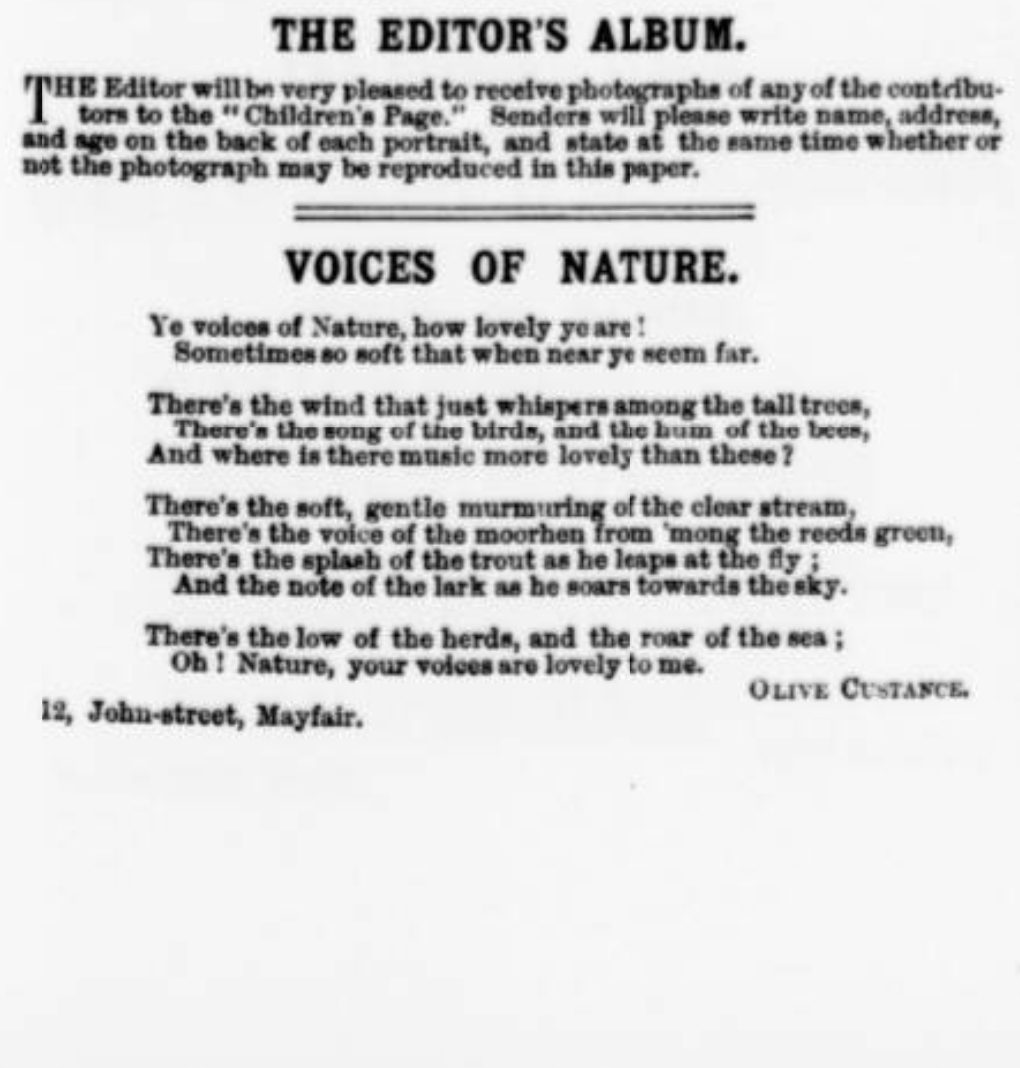
Encouraged by her mother, Olive began submitting poems to The Lady’s Pictorial in her early teens. Her first published work, Voices of Nature (1888), appeared with a brief editorial note praising her promise. This exchange began a routine of submission, comment, and revision. The editors’ advice was practical—“your writing has improved a little”—but their engagement provided her with a form of apprenticeship. The Lady’s Pictorial and The Gentlewoman offered a space where young women could learn the conventions of print culture, and Olive used it fully. Writing under her pseudonym “Wild Olive,” she gained confidence, learned editorial discipline, and began to see herself as a professional.

By the early 1890s she had travelled to France with family connections, improving her French and attending Mass regularly. Exposure to Catholic ritual and French literature deepened her sense of beauty as something sacred and disciplined rather than purely decorative. In her diary of 1895 she described Walter Pater’s Marius the Epicurean as a revelation, saying that it expressed her own soul in prose. It confirmed her belief that art and moral seriousness could coexist.

Returning to England, she moved in her mother’s social and artistic circles in Kensington and St John’s Wood. These contacts gave her access to editors and publishers, but she continued to rely on her own initiative and wrote furiously to newspapers seeking publication of her poems, and accepting any helpful advice she got back from Editors. Her father treated her literary interests with tolerant amusement, but her persistence was unmistakable.

Her chance came when The Pall Mall Magazine accepted The Parting Hour in 1895. The poem’s measured sentiment—“The sunset fades, and twilight grows apace, / The hour has come, my love, the parting hour”—and its accompanying illustration by J. Walter West perfectly suited the tastes of late-Victorian readers. Its success was immediate. The artwork featured on the Frontispiece. Remarkable for a girl of her age. Reprints appeared in newspapers across the English-speaking world, often with her name printed in bold. She was to become for a few years, one of the best-known young poets in Britain.

That success was not luck but the result of years of preparation. Through the discipline of the women’s press, she had developed technical skill, a sense of audience, and the confidence to present herself as a writer. Her upbringing, travel, and reading combined to form a distinctive voice: lyrical, restrained, and aware of beauty’s moral weight.

By the time her poem made her famous, Olive Custance was no longer an amateur. The years of practice behind her first success explain why she could step so easily into the literary world that awaited her. What looked like an effortless debut was the work of a decade spent learning her craft in private before her name reached print.

For the first time since he 1880s, we believe, here is Olive’s first ever published poem:

“Voices of Nature” – The Lady’s Pictorial, Saturday, 15 September 1888, p. 19
By Olive Custance (aged 14)

Ye voices of Nature, how lovely ye are!
Sometimes so soft that when near ye seem far.

There’s the wind that just whispers among the tall trees,
There’s the song of the birds, and the hum of the bees,
And where is there music more lovely than these?

There’s the soft, gentle murmuring of the clear stream,
There’s the voice of the moorhen from ’mong the reeds green,
There’s the splash of the trout as he leaps at the fly,
And the note of the lark as he soars towards the sky.

There’s the low of the herds, and the roar of the sea;
Oh! Nature, your voices are lovely to me.


References

  • The Lady’s Pictorial (issues from 1888–1894), featuring early poems and correspondence, often under the pseudonym “Wild Olive.”
  • The Gentlewoman (early 1890s), containing additional short verses and editorial comments.
  • Custance, Olive. Diary entries, circa 1895 (Berg Collection, New York Public Library).
  • The Pall Mall Magazine, May 1895: publication of The Parting Hour, with illustration by J. Walter West.
  • King, Edwin, (ed.), The Inn of Dreams: Poems by Olive Custance, St. Austin Press, 2015.
  • Adams, Jad. “Olive Custance: A Poet Crossing Boundaries,” English Literature in Transition, 1880–1920, vol. 61, no. 4 (2018), pp. 43–60.
  • Wintermans, Caspar. Alfred Douglas: A Poet’s Life and His Finest Work, 2007.
  • Hawkey, Nancy. Olive Custance Douglas: An Annotated Bibliography of Writings About Her, 1972.
  • McDermott, Ferdi. “Olive Custance: The Poison Pen of a Fairy Prince,” The Fortnightly Review, 23 April 2020.

Leave a comment

Filed under Uncategorized

Escape

Autumn woods, my heart is tired with wandering about 

And all my courage fails, 

O lovely woods draw close your coloured veils,

And shut the cold world out!

The little tangled branches catch my curls, the bracken makes

Strong nets to hold me fast,

But safe in Heaven my truant spirit makes 

Her bright wings free at last!

From Country Life, Vol. 46, Iss. 1194,  (Nov 22, 1919), p 649.

Leave a comment

Filed under Uncategorized

Beautiful new recordings of Olive Custance poetry

Opals

Rainbows

Inn of Dreams

Leave a comment

Filed under Uncategorized

Bosie’s poison pen: new poems and research

Abstract

The relationship of Lord and Lady Alfred Douglas was stormy, but not private. An unpublished poem of Douglas’s described it as “Forever in the Press”, and their correspdonence and poetry continues to cast light on their unlikely, enduring union. This article includes significant, unpublished original work of Lord Alfred Douglas and Olive Custance, with the permission of the estate.

 The poison pen of the Fairy Prince. Available at:

https://fortnightlyreview.co.uk/2020/04/olive-custance/


Leave a comment

Filed under Uncategorized

“Peculiar flavor” and “preoccupation with the esoteric” … a 1950s view of Custance and friends

THE EIGHTEEN-NINETIES. A Period Anthology in Prose and Verse,
Chosen by Martin Secker. London: The Richards Press. p. xvi, 616.

(Review from the Dalhousie Review, Volume 32, Number 2, 1952)

This new edition of the Anthology first published in 1948, is another indication of the considerable revival of interest in the fin de siecle which has been evident during the past few years. This phenomenon in literary taste is probably due to reaction against much hasty and slovenly writing in an age of rage, pain and uncertainty.

The inner resources are once more being summoned-by the few, at least-as providing the only solace, the only verities. It is this unconscious quest for the felicity that comes with “. . . the cultivation of the self, the consolations of art”, as John Betjeman puts it in his Introduction, that identifies the modern reader with the writers of the period . “If we do not recognize the note of rebellion,- we will hear, those of us who can hear rhythm and rhyme, the accom- paniment of sound craftsmanship.” This is what is too often neglected by the critics of the Nineties. The revolt, the determination to shock, and the Victorian social climate which brought forth such lush and often over-exuberant manifestations being now vivid only to specialists, the often exquisite manner and matter of the writers of the day – all gone now, sadly, except Max Beerbohm – seem too often to have been overlooked. They are slowly earning acceptance once more. Certainly the spell is an entrancing one, and once it claims a happy victim, holds him fast. In the Introduction, Mr. ·Betjeman has slipped into the very polished periods of the decadence to tell of the publisher-compiler Martin Secker, worthy successor John Lane, and of the reading and sifting that finally resulted in this book.

Appropriately (and inevitably, to any lover of the period) the Dedication is to Sir Max Beerbohm. In Eighteen-Eighty and Diminuendo. selected from his writings, “The Incomparable Max” gives the flavor of an age as savoured by his bitter-sweet palate. As Hotbrook Jackson points out, the New Urbanity was finely exemplified in Max’s strangely modern personality, and one sees the decadence smiling at itself in his pages. ·

It appears that the arrangement of the selections is alphabetical by author and, therefore, it is only accidentally felicitous that Aubrey Beardsley should be first on the list. One has always been curious about Under the Hill, of course, and it is re-prin ted here. :Like a good many other things in this book, it is quite unobtainable and long out of print, and one has never seen it. Beardsley died early and this unfinished fragment is his only prose work. His amazing versatility is made apparent in this collection whose frontispiece is his illustration to The Three Musicians, which poem is also reproduced.

Beardsley may not have been essential to the period but he would have been out of place elsewhere and in his brief career he epitomized the courageous and often bizarre creative personality of the day. It was, as Max Beerbohm called it, ” … the Beardsley Period.” 

At times, the peculiar flavour of much Nineties writing becomes only too apparent. It reads almost as if Dawson, Olive Custance, Lord Alfred Douglas, Wilde and Beardsley were all one. The passion for close description of lush detail, of beauty grafted to elegance ; the preoccupation with the esoteric in all manner of luxurious trappings, outlandish sights and sounds and ‘scarlet’ sins, becomes mere posing at its worst. and most ingenious invention at its best.

But there is so much more here: George Moore, HenryHarland (editor of The Yellow Book), Arthur Symons (editor of The Savoy), Richard La Gallienne, perhaps most capable of evoking the true Nineties aura, as in A Ballad of London with its much-quoted ” … iron lilies of the Strand”. Here one will find also his exquisite, wonder-inspired Ode to Spring which is far from the Strand and patchouli and Bohemia. To browse through these pages is to come across many an example of the very special concern of the Nineties men with acute observation of externals and of the things of the mind. The long complete Lovers of Orelay of George Moore is quite typical prose in this sense, while Vincent O’Sullivan’s The Lady and Arthur Symons’ In Bohemia are poems which could, one might almost say, have been written at no other time.

This eloquent and elegant selection may well inspire the desire to write well, and if it does it will justify itself even beyond its inimitable period attraction. In the broader view, the attempt being made at the end of the last century to find a way for art in a bourgeois industrial society is still going on, and the contemplation of the earlier attempts makes the Nineties of real interest and importance to-day.

R. A. O’BRIEN 


Leave a comment

Filed under Uncategorized